
No. 1 vs. No. 2 vs. Stud Grade Framing Lumber: Knots, Wane & Structural Use Guide
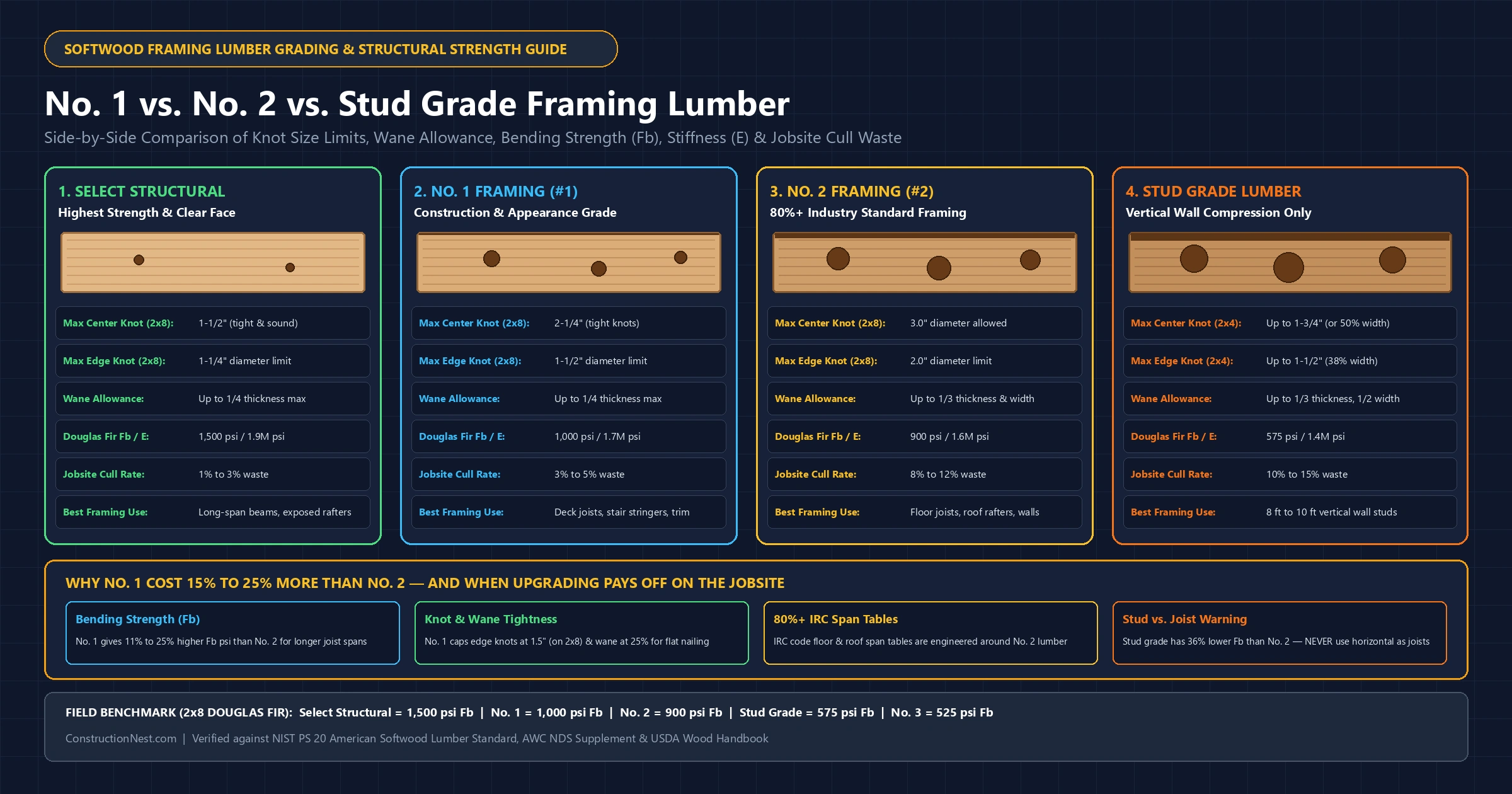
Standing in the lumber yard aisle comparing no 1 vs no 2 framing lumber can readily cost or save you $1,500+ on a single house framing package. While No. 1 boards carry 11% to 25% higher bending strength and tighter knots, No. 2 framing lumber powers over 80% of residential builds at a 15% to 25% lower price. Here is the exact grade stamp, knot size, wane, and span breakdown I use on the jobsite.
What Is the Difference Between No. 1 and No. 2 Framing Lumber?
When you compare no 1 vs no 2 framing lumber side by side, the core differences come down to maximum knot size, bark wane allowance, and allowable fiber stress in bending (Fb). Both grades are structural dimension softwood cut at 2 to 4 inches nominal thickness for load-bearing house framing.
No. 1 lumber (often called construction grade) restricts edge knots on a 2×8 joist to 1-1/2 inches and caps bark wane at 1/4 of the board thickness. That cleaner wood grain boosts Douglas fir bending strength to 1,000 psi and stiffness (modulus of elasticity, or E) to 1,700,000 psi.
No. 2 lumber (often called standard grade) allows edge knots up to 2 inches on a 2×8 and wane up to 1/3 of the thickness and width. Even with bigger defects, No. 2 Douglas fir delivers 900 psi bending strength and 1,600,000 psi stiffness, which satisfies 85% of residential building code span tables.
Before you convert your rough framing list into bundle pricing, remember that a nominal 2×8 actually measures 1.5 by 7.25 inches once planed dry. You can check our nominal vs actual lumber sizes guide so your joist hangers and header pockets match to within 1/16 inch.
Complete Softwood Framing Lumber Grades Comparison Chart (Select Structural to No. 3)
In my field experience, I’ve found that seeing all 5 softwood lumber grades in one engineering table stops contractors from overpaying by 20% on wall framing or under-sizing long deck headers. Most lumberyards stock No. 2 and stud grade in the main shed while keeping choose structural and No. 1 in special-order bunks.
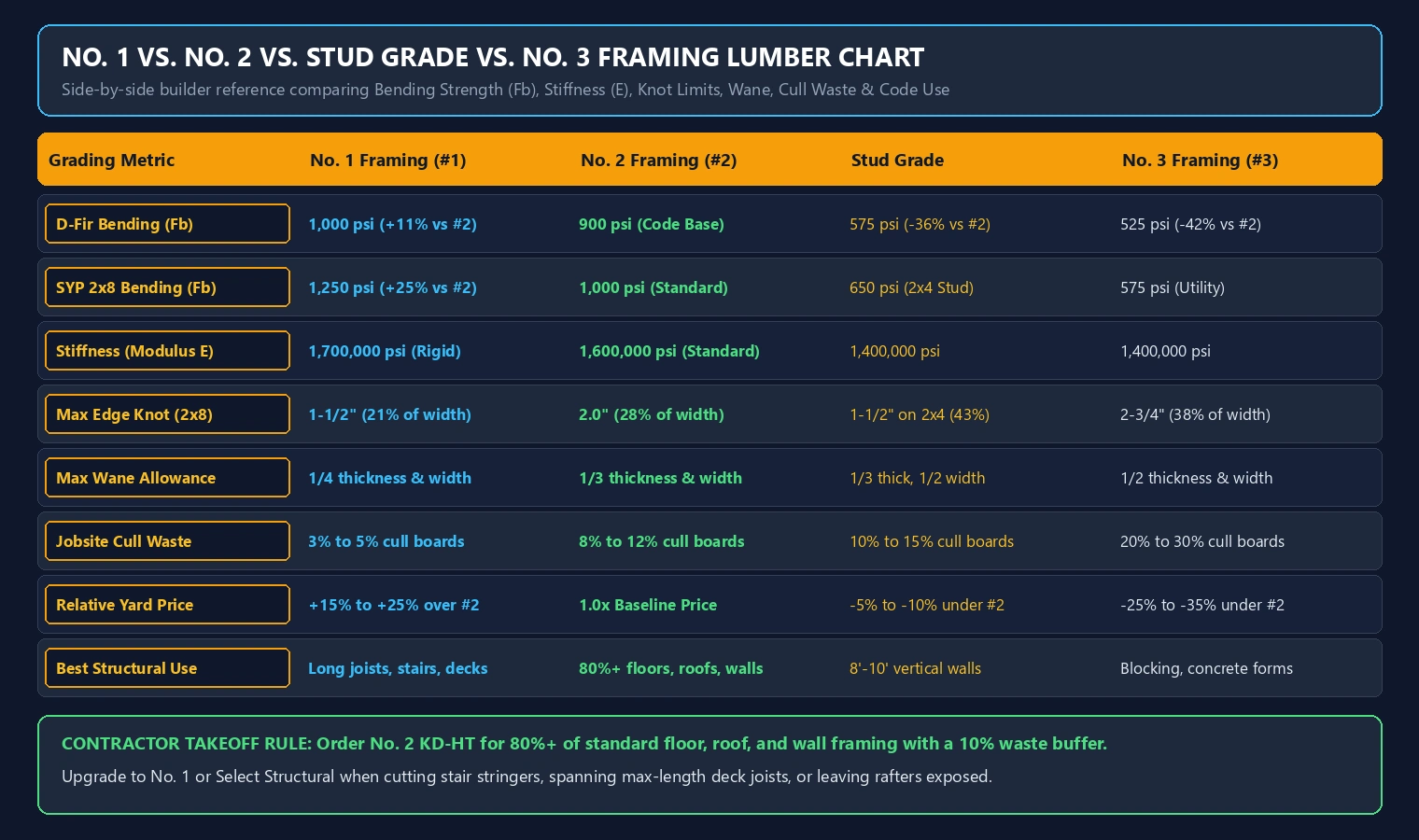
Use this master chart to compare choose structural, No. 1, No. 2, stud grade, and No. 3 framing across 8 structural and jobsite metrics.
| Framing Lumber Grade | Max Edge Knot (2×8 Joist) | Max Center Knot (2×8 Joist) | Max Wane Allowance | Douglas Fir Bending (Fb) | Stiffness Modulus (E) | Jobsite Cull Waste Rate | Best Structural Application |
|---|---|---|---|---|---|---|---|
| Choose Structural | 1-1/4 in (17% width) | 1-1/2 in tight | 1/4 thickness max | 1,500 psi | 1,900,000 psi | 1% to 3% | Exposed timber trusses, long-span headers, porch beams |
| No. 1 Framing (#1) | 1-1/2 in (21% width) | 2-1/4 in tight | 1/4 thickness & width | 1,000 psi | 1,700,000 psi | 3% to 5% | Stair stringers, exposed deck joists, long floor spans |
| No. 2 Framing (#2) | 2.0 in (28% width) | 3.0 in sound | 1/3 thickness & width | 900 psi | 1,600,000 psi | 8% to 12% | Standard floor joists, roof rafters, load-bearing walls |
| Stud Grade | 1-1/2 in (on 2×4) | 1-3/4 in (on 2×4) | 1/3 thick, 1/2 width | 575 psi | 1,400,000 psi | 10% to 15% | Vertical interior & exterior wall studs up to 10 ft tall |
| No. 3 Framing (#3) | 2-3/4 in (38% width) | 3-3/4 in or knothole | 1/2 thickness & width | 525 psi | 1,400,000 psi | 20% to 30% | Fire blocking, concrete forms, temporary bracing, crates |
Notice how choose structural and No. 1 cut your jobsite cull pile down to 1% to 5%, whereas ordering a cheap bunk of No. 3 leaves 20% to 30% of the stack twisted or split. When pricing out a house package, run your tally through our board foot calculator to compare total board footage and waste cost in under 10 seconds.
All 5 Softwood Framing Grades Explained: Knots, Wane, and Strength
Softwood grading inspectors judge every board in about 3 seconds on the sawmill chain or pass it through an X-ray density scanner. Unlike decorative hardwood lumber grades that measure clear-face cutting strips for cabinets, softwood framing grades measure how much load a full-length piece can hold without snapping.
Why does a knot on the narrow edge of a 2×8 hurt strength 2 times more than the exact same knot in the center of the board? When a floor joist bends under heavy furniture, the bottom edge pulls apart in tension while the center line experiences nearly 0 psi of bending stress.
1. Select Structural: Maximum Span and Clear Appearance
Choose structural sits at the top of the chart, keeping grain slope tighter than 1 in 12 and edge knots under 1-1/4 inches on a 2×8. Because it delivers 1,500 psi bending strength in douglas fir (66% stronger than No. 2), engineers use it for long beams and heavy snow roofs.
2. No. 1 Grade (Construction Grade): The Sweet Spot for Stairs and Decks
No. 1 framing lumber bridges high-end timber and everyday framing at a 15% to 25% premium over No. 2. In southern pine, a 2×8 in No. 1 hits 1,250 psi compared to 1,000 psi in No. 2, adding 8 to 14 inches of joist span.
For carpenters, No. 1 needs tight intergrown knots instead of loose knotholes. When you notch 2×12 stair stringers down to a 5-inch throat depth, buying No. 1 stops a 2.5-inch loose knot from weakening the bottom step.
3. No. 2 Grade (Standard Grade): The 80%+ Residential Workhorse
Walk onto 9 out of 10 home builds across the country and you will see No. 2 stamped on floor joists, rafters, and plates. Residential building codes base 100% of their standard span tables on No. 2 lumber.
While No. 2 permits center knots up to 3 inches on a 2×8 and wane across 1/3 of the face, every board carries full design loads. Adding a 10% waste buffer for crowned pieces makes No. 2 the best value per dollar.
4. Stud Grade vs. No. 2: Why You Must Never Use Stud Grade as a Floor Joist
A serious mistake a homeowner can make is grabbing a 10-foot stud grade 2×6 and nailing it flat as a deck joist. Stud grade is graded purely for vertical walls 8 to 10 feet high where loads push straight down.
Because vertical walls face low sideways bending, rules let stud grade knots cover 38% to 50% of the width. That drops douglas fir bending strength to 575 psi—which is 36% weaker than a 900 psi No. 2 board!
5. No. 3 and Utility Grade: Non-Structural Blocking and Formwork
Once a plank shows knotholes up to 3-3/4 inches on a 2×8 or wane across 50% of its thickness, the mill stamps it No. 3. With strength at 525 psi and a 20% to 30% cull rate, save No. 3 for blocking and concrete forms.
How to Read a Framing Lumber Grade Stamp (5 Key Marks Decoded)
I’ve handled cases exactly like this before where a building inspector red-tagged a second-story floor deck because the crew trimmed the ink grade stamp off 14 joists while squaring the ends. Without a readable stamp, inspectors must treat boards as unranked stock with 0% verified span capacity.
Every certified piece of North American framing lumber carries a black ink stamp with 5 mandatory marks:
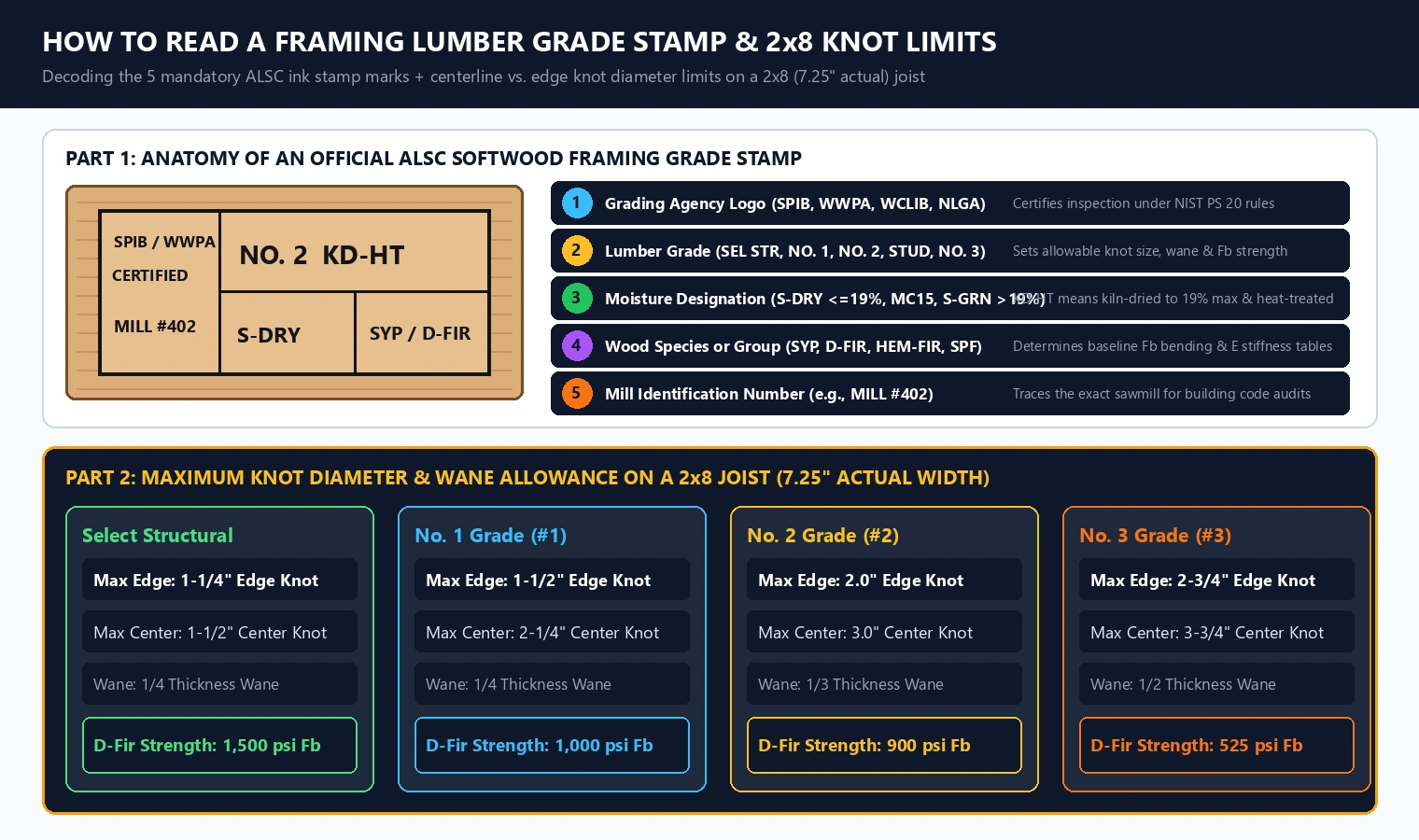
First, find the grading agency logo—like SPIB, WWPA, WCLIB, or NLGA—plus the mill number (like Mill #402). These 2 marks prove a licenced inspector audited the sawmill.
Second, check the grade name (SEL STR, NO. 1, NO. 2, or STUD) and moisture tag: S-DRY (19% max moisture), MC15 (15% max), or S-GRN (above 19%). Check our kiln dried vs air dried lumber guide before hanging drywall over wet studs.
According to structural wood grading course standards from Missouri University of Science and Technology, dimension softwood framing grades under American Softwood Lumber Standard PS 20 receive allowable stress values across 100% of licenced mills based on knot spot and wane. Always turn joists so the ink stamp faces down for a fast 2-second inspection.
Species Matters Too: Southern Yellow Pine vs. Douglas Fir vs. SPF in No. 1 and No. 2
Many builders adopt any No. 2 2×10 has the exact same strength regardless of species. In reality, wood species changes your allowable joist span just as much as jumping from No. 2 to No. 1.
According to wood engineering research from the USDA Forest Products Laboratory, higher particular gravity in dense softwoods like southern pine and douglas fir boosts bending stiffness by 15% to 30% over lighter spruce-pine-fir (SPF) timber. Compare how the 4 main framing species perform:
- Douglas Fir-Larch (D-Fir): Offers 1,000 psi Fb in No. 1 and 900 psi in No. 2 with 1.6M to 1.7M psi stiffness for 16-foot floor spans.
- Southern Yellow Pine (SYP): Dense timber hitting 1,250 psi Fb in No. 1 (2×8) and 1,000 psi in No. 2; top option for pressure-treated decks.
- Spruce-Pine-Fir (SPF): Rated at 875 psi Fb in No. 1/No. 2 and 1,400,000 psi E; popular for walls because a 2×4 weighs just 9 pounds.
- Hem-Fir (Hemlock-Fir): Straight-grained wood rated at 975 psi Fb in No. 1 and 850 psi in No. 2 for rafters and plates.
For instance, a 2×10 floor joist at 16 inches on center under a 40 psf live load spans 15 feet 8 inches in No. 2 SPF, 16 feet 1 inch in No. 2 D-Fir, and 16 feet 5 inches in No. 1 D-Fir. Upgrading from No. 2 SPF to No. 1 D-Fir adds 9 inches of clear span without buying 2×12 stock!
When Should You Pay Extra for No. 1 Instead of No. 2 Framing Lumber?
I’ve seen this pattern many times in my work when reviewing framing bids for home additions and decks. A builder either orders No. 1 for hidden closet walls—wasting $2,200—or uses snarled No. 2 on a jagged staircase that squeaks within 90 days.
Pay the added 15% to 25% for No. 1 (or choose structural) in these 4 high-load spots:
- Jagged Stair Stringers (2×12): Cutting steps removes over 50% of an 11.25-inch board; No. 1 keeps 3-inch loose knots out of the 5-inch throat.
- Exposed Pergolas and Deck Framing: Where wood receives stain or paint, No. 1 gives 2 times cleaner square edges with slight bark wane.
- Max-Span Joists and Cantilevers: Jumping to No. 1 adds 100,000 psi of stiffness to stop floor bounce on max-span 2×10 joists.
- Tall Tile Shower & Kitchen Walls: Straight No. 1 studs behind 10-foot tile walls save 3 to 4 hours of planing bowed boards.
According to wood drying guidance from Ohio State University Extension, uneven shrinkage around large knots raises bow, crook, and twist as boards dry below the 30% fiber saturation point. When laying out sill plates and headers, total your run lengths in our linear feet calculator and browse all tools in our construction calculators hub.
Frequently Asked Questions About No. 1 vs. No. 2 Framing Lumber
In my field experience, I’ve found that clearing up grade-stamp confusion before placing a lumberyard order stops 90% of failed framing inspections and pricey restocking fees. Here are direct answers to the 5 most frequent questions builders and homeowners ask.
Is number 2 lumber better than number 1?
No—No. 1 lumber is higher quality and stronger than No. 2 lumber. On a 2×8 Douglas fir joist, No. 1 caps edge knots at 1-1/2 inches and delivers 1,000 psi bending strength, while No. 2 allows 2-inch edge knots and rates at 900 psi. Still, No. 2 is more popular because it meets 80%+ of building code spans for 15% to 25% less money.
What is the best grade of framing lumber?
Choose Structural is the highest and strongest standard grade of dimensional softwood framing lumber. In Douglas fir, Choose Structural gives 1,500 psi bending strength and 1,900,000 psi stiffness with bark wane limited to 1/4 thickness and only 1% to 3% jobsite waste.
What is better, #2 or #3 lumber?
No. 2 (#2) lumber is far better and almost 2 times stronger in bending than No. 3 (#3) lumber (900 psi vs. 525 psi in Douglas fir). Use No. 2 for all load-bearing floor joists, roof rafters, and walls, and qualify No. 3 to non-structural blocking, concrete forms, and temporary bracing where a 20% to 30% cull rate will not hurt the frame.
What is the difference between Douglas fir #1 and #2?
The difference between Douglas fir #1 and #2 is an 11% jump in bending strength (1,000 psi for #1 vs. 900 psi for #2), a 100,000 psi increase in stiffness (1.7M psi vs. 1.6M psi), and tighter defect limits: #1 restricts 2×8 centerline knots to 2-1/4 inches and wane to 1/4 thickness, while #2 permits 3-inch center knots and 1/3 wane.
Can I use Stud grade 2×4 or 2×6 lumber for floor joists or roof rafters?
Never use stud grade lumber horizontally for floor joists, ceiling joists, or roof rafters. Stud grade is engineered purely for vertical wall compression up to 10 feet tall and carries only 575 psi bending strength in Douglas fir—which is 36% weaker than the 900 psi needed by standard No. 2 joist span tables.
Final Thoughts on Choosing No. 1 vs. No. 2 vs. Stud Grade Framing Lumber
In my field experience, I’ve found that selecting between no 1 vs no 2 framing lumber is straightforward once you match the grade to the structural load: order No. 2 KD-HT with a 10% waste allowance for 80% of your standard floors, roofs, and walls, and step up to No. 1 or choose structural for stair stringers, long-span deck joists, and exposed beams.
Always check all 5 marks on the ink grade stamp before unloading your trailer, crown every joist upward, and never lay a 575 psi stud grade board flat as a horizontal joist. Tally your final board footage before ordering so your framing package arrives 100% complete on day 1.