How Sawmills & Lumber Yards Price Hardwood by MBF (Per 1,000 Board Feet)
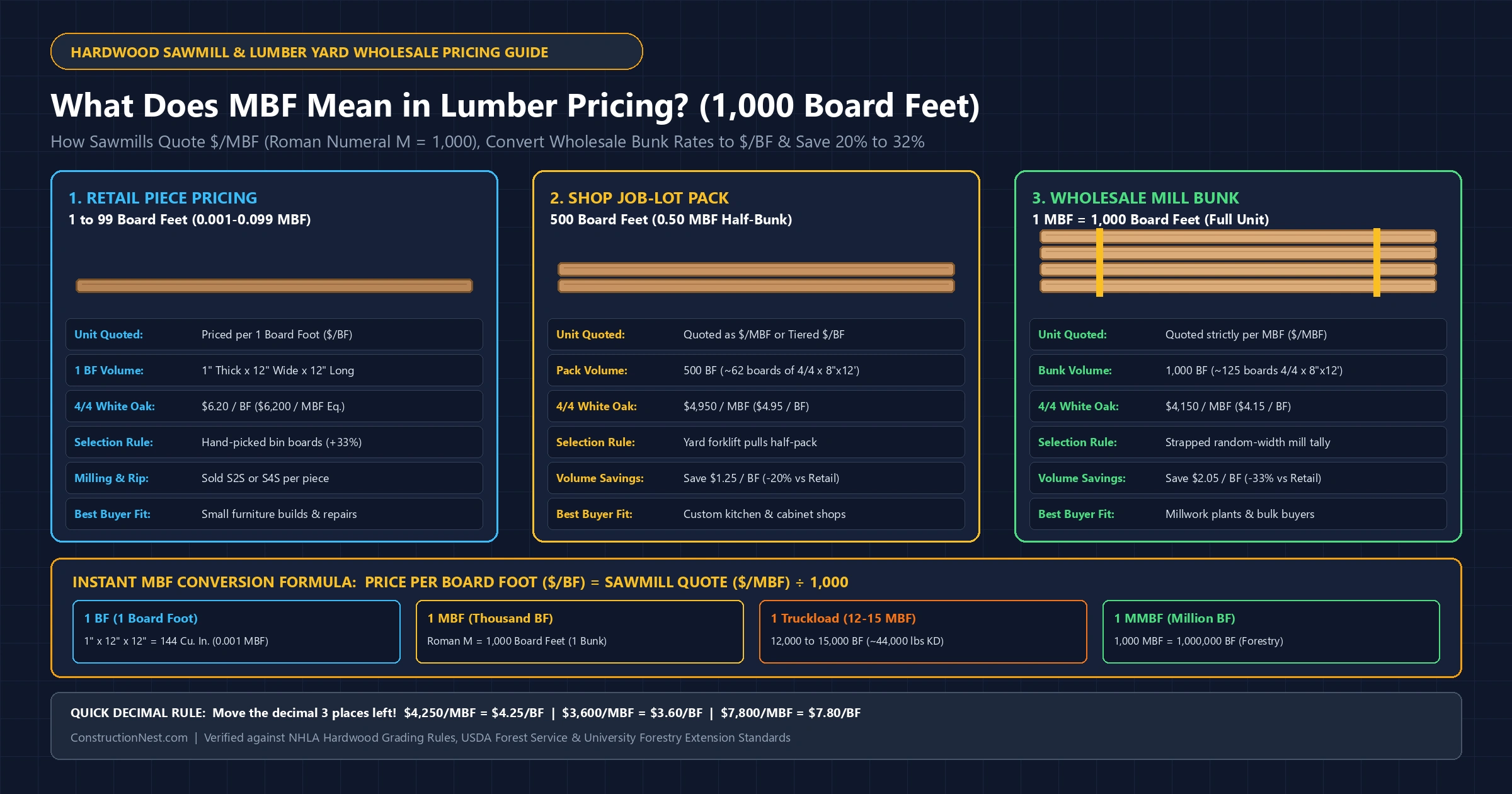
Opening a wholesale sawmill quote for the first time and asking what does mbf mean in lumber pricing can save you from a massive ordering error. In the hardwood and timber trade, MBF stands for 1,000 board feet (never 1 million!), because the letter M comes from the Roman numeral for 1,000. Below is the exact lumber pricing math, decimal conversion rule, and wholesale bunk comparison chart I use to turn $/MBF mill sheets into per-board-foot shop costs in 5 seconds.
What Does MBF Mean in Lumber Pricing? (The Roman Numeral Rule Explained)
When a commercial sawmill or wholesale lumber yard emails a price sheet, they nearly never list prices for a single board foot. Instead, every line item is quoted per MBF, which means price per thousand board feet (1,000 BF).
The letter M is the classical Roman numeral for 1,000 (from the Latin word mille), while BF stands for board feet. You will also see wholesale yards print MBFT, M Bd. Ft., or merely /M on invoices—all 4 abbreviations mean the exact same volume of 1,000 board feet.
To picture how much wood sits inside 1 MBF, start with a single board foot (1 BDFT). One board foot is a block of lumber measuring 1 inch thick by 12 inches wide by 12 inches long, which equals 144 cubic inches of wood.
Multiply that single block by 1,000 and you get 1 MBF, or a strapped steel-banded sawmill unit (called a bunk) holding around 125 boards of 4/4 (1-inch) stock measuring 8 inches wide by 12 feet long. Depending on species moisture, a single 1 MBF bunk of kiln-dried oak weighs between 3,600 and 4,200 pounds.
How to Convert $/MBF Quotes to Price Per Board Foot (Step-by-Step Math)
In my field experience, I’ve found that moving the decimal point 3 places to the left is the fastest shop trick for reading wholesale lumber quotes without a calculator. Because 1 MBF equals 1,000 board feet, dividing any $/MBF quote by 1,000 gives you the exact price per board foot ($/BF).
Going the other direction is just as easy when comparing a local retail store against a wholesale distributor. Multiply a retail per board foot price by 1,000 (move the decimal 3 places right) to see what that store is charging on an equivalent MBF basis.
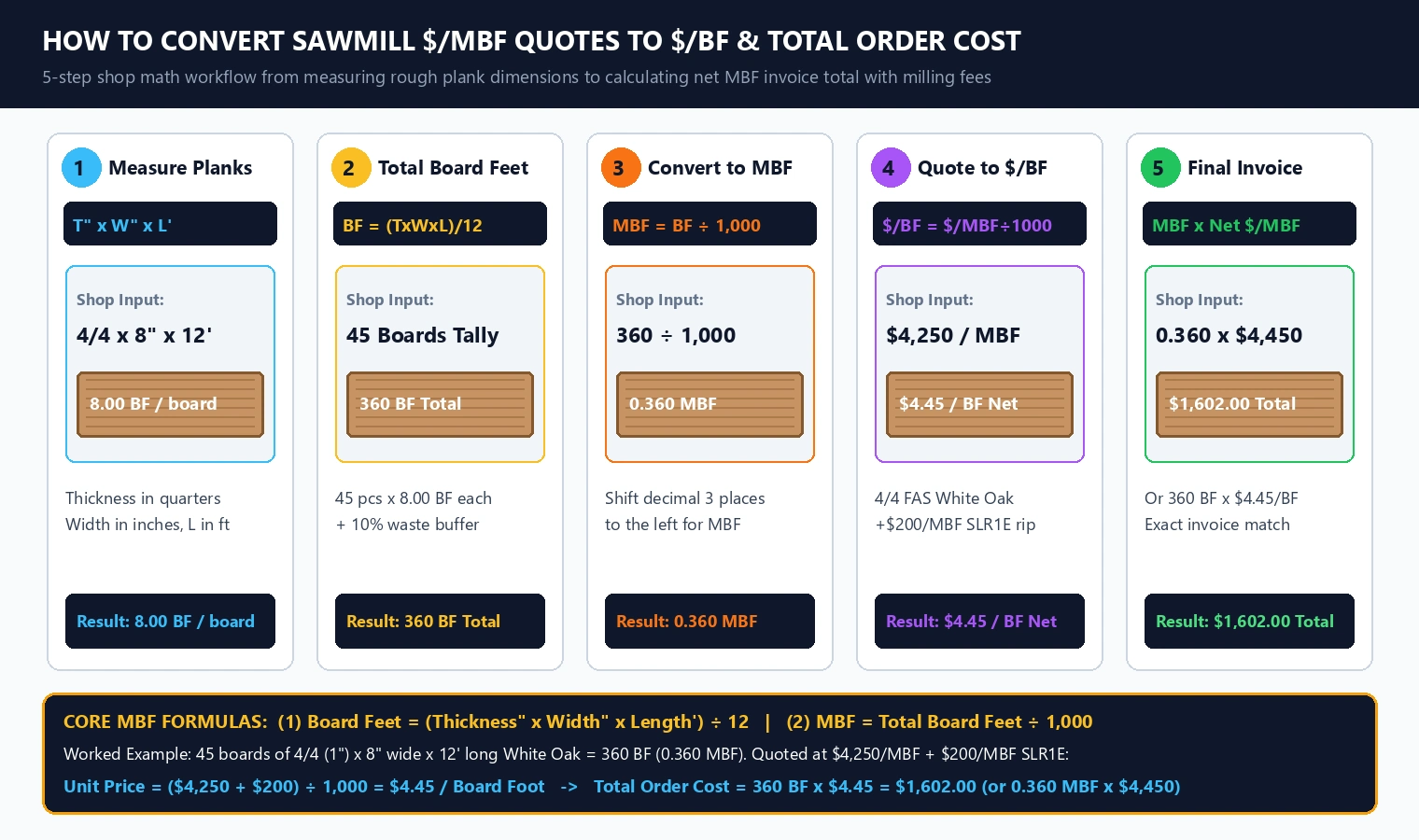
Before you can multiply your price, you have to calculate board feet for your cut list using the standard board foot formula. Multiply rough thickness in inches by width in inches by length in feet, then divide that number by 12.
Once you have your total board footage, divide your board feet by 1,000 to convert the order into MBF units. For instance, a cabinet job needing 450 board feet of maple equals 0.450 MBF on a wholesale buy order.
Worked Pricing Examples: Converting Wholesale Mill Quotes Into Shop Costs
Let’s walk through 3 real shop quotes so you can see how pricing conversion lumber math works on actual invoices. Notice how even a small $250/MBF change only shifts the single board foot price by $0.25/BF:
- Example 1 (4/4 FAS White Oak Bunk): A distributor quotes $4,150/MBF. Divide $4,150 by 1,000 to get $4.15 per board foot. Ordering 600 board feet (0.600 MBF) costs 600 × $4.15 = $2,490.00.
- Example 2 (8/4 Pick Hard Maple Lot): A mill quotes $3,850/MBF for thick 2-inch stock. Moving the decimal 3 places left gives $3.85/BF, so a 250 BF (0.250 MBF) workbench order totals $962.50.
- Example 3 (Comparing Retail vs. MBF): Your local retail bin sells 4/4 walnut at $11.20/BF (which equals $11,200/MBF), while a wholesale yard quotes $7,800/MBF ($7.80/BF)—saving you $3.40 per board foot or $3,400 on a 1,000 board feet order.
If you don’t want to run manual board foot calculations on mixed widths and lengths, plug your piece counts into our board foot calculator to get your exact board footage and total cost in under 10 seconds.
Retail Per-Board-Foot vs. 500 BF Pack vs. 1 MBF Wholesale Bunk Pricing Chart
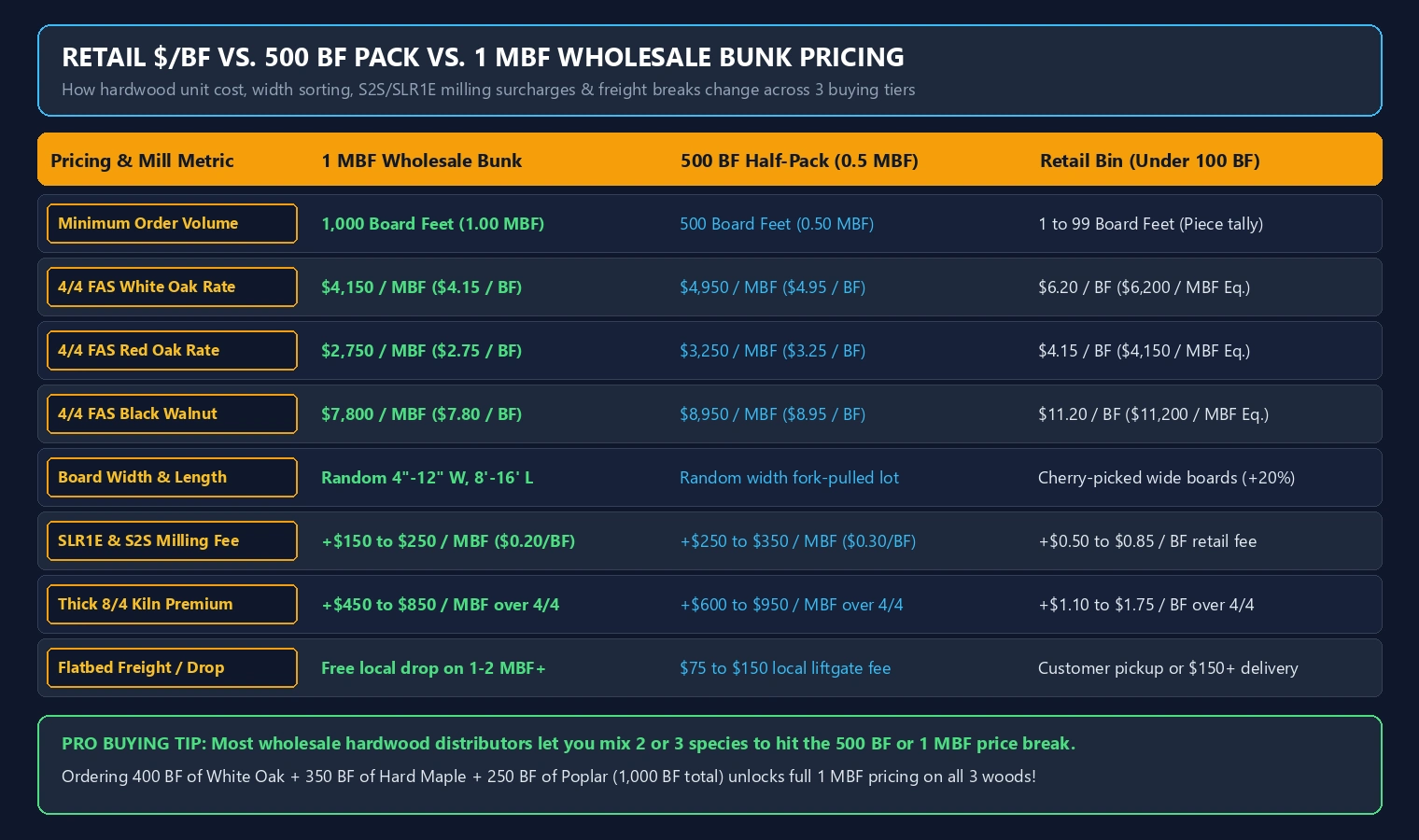
Hardwood suppliers use tiered bulk lumber pricing to reward shops that buy in forklift-ready bundles instead of picking through racks by hand. When a yard worker has to pull 12 pieces of cherry one board at a time, labor drives the price up by 25% to 35%.
Buying a half-pack (500 board feet or 0.50 MBF) or a full strapped unit (1 MBF or 1,000 board feet) lets the operator load your truck with 1 forklift pick in 3 minutes. Here’s how retail bin rates compare against 500 BF and 1 MBF wholesale quotes across 6 popular North American hardwoods.
| Hardwood Species (4/4 Kiln-Dried FAS) | Retail Piece Price (1–99 BF) | 500 BF Half-Pack Quote (0.5 MBF) | 1 MBF Wholesale Bunk Quote ($/MBF) | Useful Price per BF at 1 MBF | Total Savings on 1,000 BF vs. Retail |
|---|---|---|---|---|---|
| 4/4 Red Oak (FAS) | $4.15 / BF ($4,150/MBF eq.) | $3,250 / MBF ($3.25/BF) | $2,750 / MBF | $2.75 / BF | $1,400 saved (-33.7%) |
| 4/4 White Oak (FAS) | $6.20 / BF ($6,200/MBF eq.) | $4,950 / MBF ($4.95/BF) | $4,150 / MBF | $4.15 / BF | $2,050 saved (-33.1%) |
| 4/4 Hard Maple (Pick) | $4.85 / BF ($4,850/MBF eq.) | $3,850 / MBF ($3.85/BF) | $3,300 / MBF | $3.30 / BF | $1,550 saved (-32.0%) |
| 4/4 American Cherry (FAS) | $4.60 / BF ($4,600/MBF eq.) | $3,650 / MBF ($3.65/BF) | $3,100 / MBF | $3.10 / BF | $1,500 saved (-32.6%) |
| 4/4 Black Walnut (FAS) | $11.20 / BF ($11,200/MBF eq.) | $8,950 / MBF ($8.95/BF) | $7,800 / MBF | $7.80 / BF | $3,400 saved (-30.4%) |
| 4/4 Poplar (FAS / S2S) | $3.10 / BF ($3,100/MBF eq.) | $2,400 / MBF ($2.40/BF) | $1,950 / MBF | $1.95 / BF | $1,150 saved (-37.1%) |
Look closely at the middle column: you don’t always have to buy a full 1,000 board feet of one species to unlock wholesale lumber prices. Most regional distributors let cabinet shops mix 300 BF of white oak, 400 BF of maple, and 300 BF of poplar to hit the 1 MBF volume bracket across the combined invoice.
How Sawmills Tally Random-Width Bunks and Add Processing Upcharges
I’ve handled cases exactly like this before when auditing millwork invoices where a contractor budgeted for the base $/MBF quote but forgot to add thickness, rending, and width-sorting surcharges that tacked $650/MBF onto the bill. Knowing how a sawmill packages and bills a unit keeps your project bid profitable.
Unlike softwood framing 2×4 studs that come stamped in exact widths, wholesale hardwood is sold in random widths (4 to 12+ inches) and random lengths (8 to 16 feet). At the mill, an automated optical scanner or tallyman with a rule measures each board and rounds its surface area to the nearest whole board foot.
A sealed 1 MBF bunk arrives strapped with a plastic tally sheet stapled to the end grain showing the exact piece count per length—like 18 pieces of 8-foot, 42 pieces of 10-foot, and 55 pieces of 12-foot boards totaling 1,014 board feet (1.014 MBF). You pay for the exact tallied board footage inside that exact bundle.
Beyond the base rough lumber rate, watch out for these 4 standard millwork add-ons billed per MBF:
- Thickness Premiums (5/4, 6/4, 8/4, 12/4): Thick 8/4 (2-inch) boards take 2 to 3 times longer to kiln dry without cracking, so mills charge $450 to $850/MBF more than 4/4 stock. See our hardwood lumber thickness chart for exact rough-to-surfaced dimensions.
- Straight-Line Rip One Edge (SLR1E): Having the yard laser-rip 1 dead-straight glue edge costs $120 to $200/MBF (only $0.12 to $0.20/BF) and saves hours at your jointer.
- Hit-or-Miss Planing (S2S vs. S4S): Planing rough 4/4 boards smooth on two faces to 13/16 inch (S2S) adds $150 to $250/MBF. Check our guide on S2S vs S4S lumber to compare mill surfacing tolerances.
- Width & Length Sorting Fees: Asking a yard to pull all 10-inch wide boards or all 14-foot lengths breaks their random-width bunk and triggers a $300 to $600/MBF sorting surcharge.
MBF vs. MMBF vs. Linear Feet: Avoiding the $10,000 Ordering Mistake
Mixing up Roman numeral abbreviations is the most costly mistake a new buyer or landowner can make when signing lumber buying contracts. Because M equals 1,000, writing two M’s side by side (MMBF) means a thousand thousands—or 1,000,000 board feet (one million board feet)!
According to forestry marketing guidance from University of Illinois Extension, standing timber harvests and sawlog sales are priced per MBF (1,000 board feet) using log rules like Doyle, Scribner, or International 1/4-Inch, where a single mature veneer walnut or white oak tree may scale between 300 and 800 board feet (0.3 to 0.8 MBF).
Meanwhile, large commercial sawmills track their annual production in MMBF (million board feet), where a single regional mill cuts 15 to 40 MMBF per year. Puzzling 10 MBF (less than 1 flatbed truckload) with 10 MMBF (approximately 750 semi-truck loads) throws an estimate off by a factor of 1,000.
Shop buyers also get tripped up when switching between MBF (a 3D volume unit) and linear feet (a 1D length measurement). If a trim supplier quotes 4/4 × 6-inch poplar baseboard stock at $2,200/MBF, each 1 linear foot holds exactly 0.5 board feet—meaning your cost per linear foot is half the per board foot price, or $1.10 per linear foot. Use our linear feet calculator to convert run lengths into board footage in 5 seconds.
How NHLA Lumber Grades and Waste Factors Change Your Real Cost Per MBF
I’ve seen this pattern many times in my work when a furniture shop buys a bargain bunk of #1 Frequent oak at $1,950/MBF to save $800/MBF over FAS grade, only to spend $1,200 in additional sawyer labor cutting around knots. The sticker price per MBF never tells the whole story until you factor in grade yield and shrinkage waste.
According to hardwood grading standards defined by Penn State Extension, National Hardwood Lumber Association (NHLA) grades find the percentage of knot-free clear wood in each board: top FAS boards yield at least 83.3% clear-face cuttings (10/12ths), while #1 Frequent yields 66.7% (8/12ths) and #2A Frequent drops to 50.0% (6/12ths).
That yield gap means buying 1 MBF (1,000 board feet) of #1 Frequent hardwood only gives you about 667 board feet of usable clear cabinet parts after rending out bark wane, pith, and knots. To wind up with 1,000 board feet of net clear furniture parts, you actually have to buy 1.35 to 1.50 MBF of rough typical lumber. Compare clear cutting sizes across every tier in our hardwood lumber grades guide.
Furthermore, kiln drying and straight-line rending shrink gross volume before a board reaches your glue rack. According to wood drying data from the USDA Forest Products Laboratory, hardwood planks lose 6% to 8% of their width to tangential shrinkage during kiln drying, and wholesale tally rules often record green or pre-ripped volume. Always add a 15% to 20% waste allowance on FAS orders (and 30% to 35% on #1 Frequent) and explore our construction calculators hub to keep every material estimate tight.
Frequently Asked Questions About MBF Lumber Pricing
Whether you are requesting truckload lumber quotes or buying your first 500 BF shop pack, getting your unit conversions right protects your profit margin on 100% of your bids. Here are clear answers to the 5 most frequent questions about MBF pricing.
How to calculate MBF for lumber?
First, calculate total board feet using (Thickness in inches × Width in inches × Length in feet) ÷ 12, then divide your total board feet by 1,000. For instance, 75 boards measuring 1″ × 8″ × 10′ equal 500 board feet, which is 0.50 MBF.
What does MBF mean in construction and forestry?
In construction, sawmilling, and forestry, MBF stands for 1,000 board feet (where M is the Roman numeral for 1,000 and BF means board feet). One MBF equals 144,000 cubic inches or 83.33 cubic feet of solid wood.
What is MBF pricing at a lumber yard?
MBF pricing is the wholesale approach of quoting lumber per 1,000 board feet instead of per single board foot. To convert any $/MBF price into price per board foot ($/BF), divide the MBF price by 1,000 (for instance, $3,500/MBF = $3.50/BF).
How many board feet are in 1 MBF vs. 1 MMBF?
There are exactly 1,000 board feet in 1 MBF, and there are 1,000,000 board feet (one million board feet, or 1,000 MBF) in 1 MMBF. Never write MMBF on a shop buy order when you only want 1,000 board feet.
How many board feet of hardwood fit on a full flatbed truckload?
A standard 48-foot or 53-foot flatbed semi-truck carries 12 to 15 MBF (12,000 to 15,000 board feet) of kiln-dried 4/4 oak or maple, or 18 to 22 MBF of lighter softwoods and poplar, capped by the legal 44,000 to 48,000 lb cargo weight limit.
Final Thoughts on Buying Hardwood by the Thousand Board Feet (MBF)
In my field experience, I’ve found that mastering what does mbf mean in lumber pricing gives small cabinet shops the confidence to bypass retail bins and save 20% to 33% at wholesale hardwood yards. Just divide any $/MBF quote by 1,000 (move the decimal 3 places left) to see your exact cost per board foot.
Before locking in your next 500 BF half-pack or 1 MBF unit, confirm whether the quote covers rough or S2S planed stock, factor in $150 to $250/MBF for straight-line rending, and add a 15% to 30% grade waste buffer so your shop never runs short.