
Add up lengths, convert square feet, and get pieces to buy.
Use this free linear feet calculator to add up trim, fence, decking or pipe and see what to buy. Try the default: 2 × 12 ft + 2 × 9 ft + 1 × 6 ft = 48 ft net. With 10% waste that is 52.8 linear feet, or 7 pieces of 8 ft. It also changes square feet to linear feet and finds a room perimeter.
It takes less than a minute to total your lengths.
Choose Cut List to add pieces, Sq Ft to Linear Ft to change area to length, Room Perimeter for a room or yard, or Linear Ft to Sq Ft to see coverage.
Type each length, the quantity and the unit. Use feet and inches (like 7 ft 6 in), yards or meters if you like. The default is 2 × 12 ft, 2 × 9 ft and 1 × 6 ft.
Pick a waste %. Use 10% for most trim. Pick Custom for your own number.
Choose the stock length (like 8 ft) to see the pieces to buy. Add a price per linear foot to see the cost.
Check net and gross linear feet. Then copy the summary table, share the link or download the PDF report.
A linear feet calculator gives you one number: how many feet of length you need to buy. Trim, fence, decking, pipe and flooring boards are all sold this way. Get this number wrong and you make a second trip to the store.
A linear foot is 12 inches of length in a straight line. It does not care about width or thickness. An 8 foot board is 8 linear feet if it is 2 inches wide or 12 inches wide.
People also say lineal feet or running feet. They all mean the same thing. The calculator adds up your cut list, changes every unit to feet, then adds waste.
Here are the formulas the calculator uses:
Gross Linear Feet = Net Linear Feet × (1 + Waste %)
Pieces to Buy = Gross Linear Feet ÷ Piece Length
Linear Feet from Area = Area (sq ft) ÷ (Board Width in inches ÷ 12)
Room Perimeter = 2 × (Length + Width) − Openings
Units change to feet like this: inches ÷ 12, yards × 3, meters ÷ 0.3048, centimeters ÷ 30.48. For feet and inches, 7 ft 6 in is 7 + 6 ÷ 12 = 7.5 ft.
We round linear feet to 2 decimals. We always round the piece count up, because you cannot buy half a board.
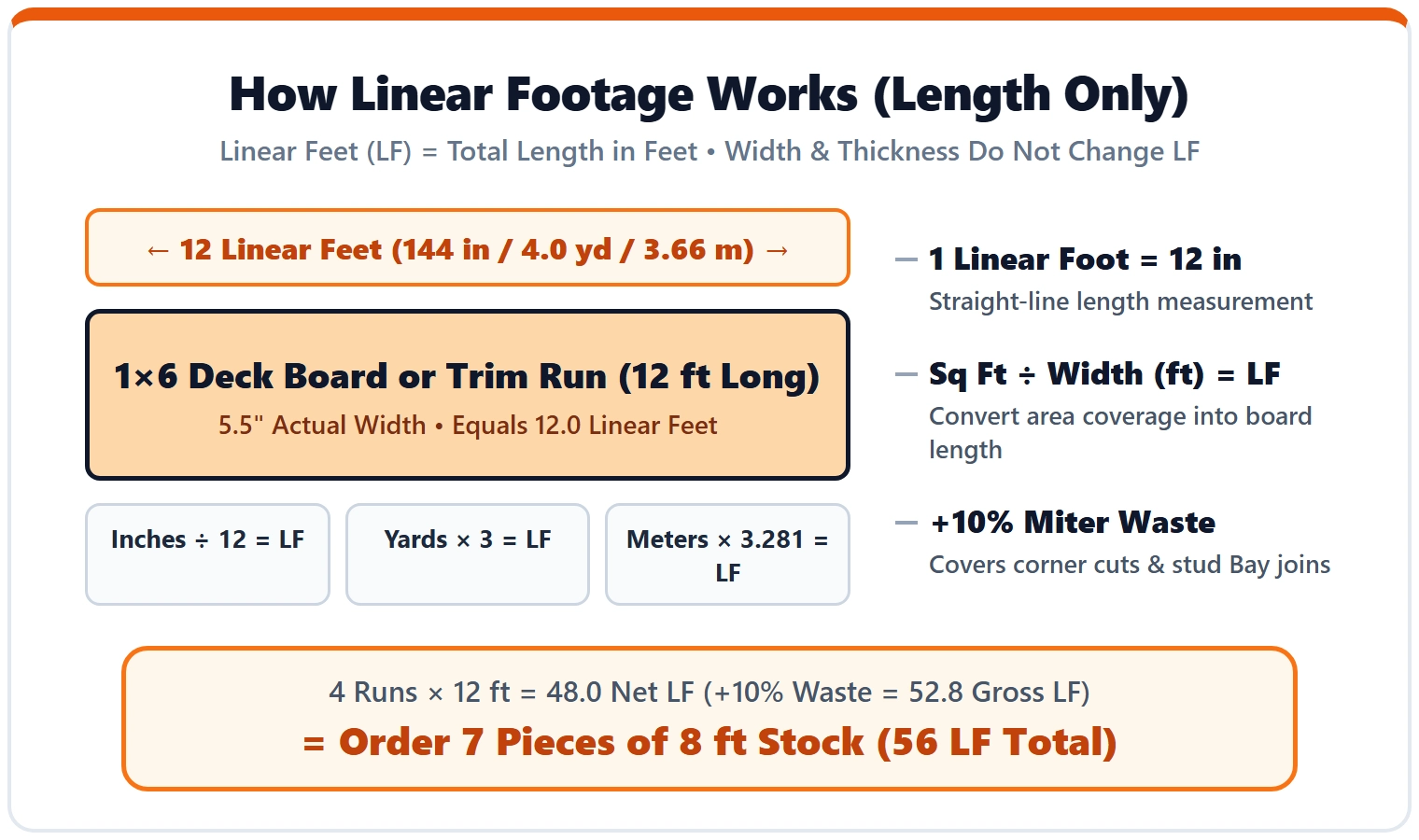
I’ve handled jobs exactly like this before. A room needs trim on four walls and a closet return. The cut list has 2 pieces at 12 ft, 2 pieces at 9 ft and 1 piece at 6 ft.
Net Linear Feet = (2 × 12) + (2 × 9) + (1 × 6) = 48 ft
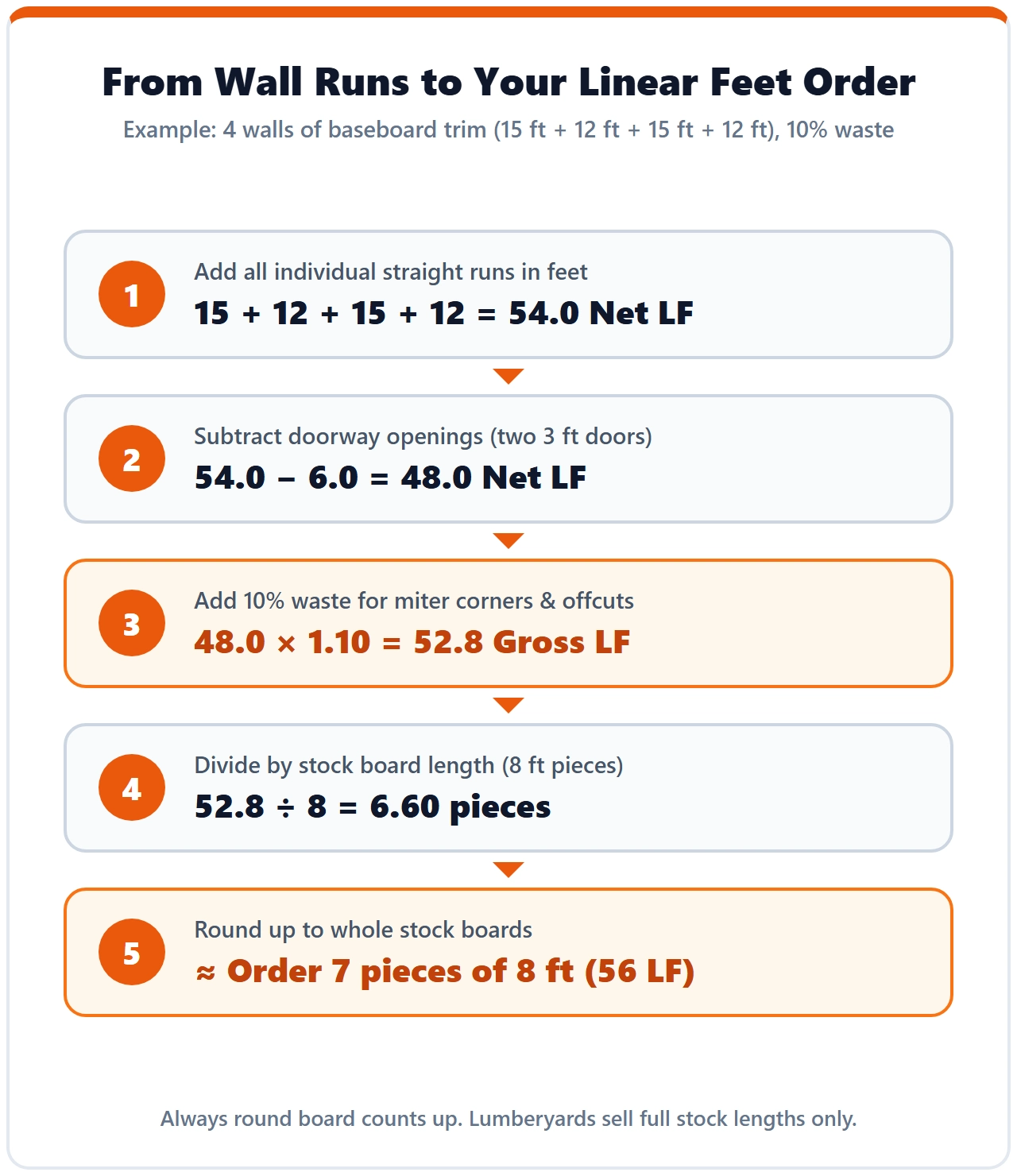
Add 10% waste: 48 × 1.10 = 52.8 linear feet. Trim is sold in 8 ft pieces, so 52.8 ÷ 8 = 6.6. Round up to 7 pieces, which is 56 ft.
You will have 3.2 ft left over. At $1.50 per linear foot, 56 ft costs $84.00. You pay for the full pieces, not just the 52.8 ft.
Say you have 320 sq ft to cover with 3.25 inch wide boards. The board width in feet is 3.25 ÷ 12 = 0.2708 ft.
Linear Feet = 320 sq ft ÷ 0.2708 ft = 1,181.54 ft
Add 10% waste and you get 1,299.69, so order about 1,300 linear feet.
A room is 12 ft by 14 ft. The perimeter is 2 × (12 + 14) = 52 ft. Take away one 3 ft door and you have 49 ft. With 10% waste that is 53.9 ft, or 7 pieces of 8 ft.
A fence works the same way. A 50 ft by 80 ft yard has a 260 ft perimeter. Take out one 4 ft gate and you get 256 ft. Add 10% waste for 281.6 linear feet of fencing.
In my professional experience, most people add too little waste. Boards come in set lengths, so you always lose some at the ends. Angled cuts lose more.
Here is what I use as a starting point. These are rules of thumb from the job site. They are not a published standard.
| Project | Waste to Add | 48 ft Net Becomes |
|---|---|---|
| Straight runs, simple layout | 5% | 50.4 ft |
| Baseboard and standard trim | 10% | 52.8 ft |
| Rooms with many corners | 15% | 55.2 ft |
| Crown molding, diagonal cuts | 20% | 57.6 ft |
For hardwood and other flooring, the maker often gives its own waste number. Use that number if it is higher than mine. Paint-grade trim needs a little less waste than stain-grade trim, because you can fill and paint small gaps.
I’ve seen this pattern many times in my work. A customer gives the store a room size in square feet, but the trim or board is sold by the foot. The two numbers cannot swap unless you know the board width.
Square feet measure area. That is length times width. Linear feet measure length only. A 10 ft by 12 ft room is 120 sq ft. The same room needs a very different order depending on the board you pick:
| Board Face Width | Linear Feet for 120 sq ft |
|---|---|
| 3 in | 480 ft |
| 4 in | 360 ft |
| 5 in | 288 ft |
| 6 in | 240 ft |
Use the face width, which is the part you can see after the board is installed. Do not use the name size. A 2×6 is not 6 inches wide. It is about 5.5 inches.
Deck boards have gaps. A 5.5 inch board with a 1/4 inch gap covers 5.75 inches. Enter 5.5 for the width and 0.25 for the gap, and the calculator does the rest.
These are the mistakes I fix most often:
If each wall needs its own boards, run the calculator one wall at a time. Short offcuts often cannot be reused, so the piece count goes up.
In my professional experience, a supplier may quote in feet while your plan is in meters or yards. A quick check saves money. The inch, yard and meter sizes below come from the exact definition of the foot, which is 0.3048 meters.
According to the National Institute of Standards and Technology, the international foot is 0.3048 meter exactly, and the older U.S. survey foot is now outdated. That is why we use 0.3048 for every meter change in the calculator.
| Linear Feet | Inches | Yards | Meters |
|---|---|---|---|
| 1 ft | 12 in | 0.33 yd | 0.3048 m |
| 25 ft | 300 in | 8.33 yd | 7.62 m |
| 100 ft | 1,200 in | 33.33 yd | 30.48 m |
| 300 ft | 3,600 in | 100 yd | 91.44 m |
Projects that use linear feet include baseboard, crown molding, fencing, decking, conduit, pipe and gutters. Lumber is a bit different. Our board foot calculator adds thickness, while linear feet count length only.
This tool gives a planning estimate. It does not know your saw cuts, your corners or a bent board. Measure each run twice, and check the number with your supplier before you order a large job.
Unit factors follow the NIST Guide for the Use of the International System of Units, which includes a conversion factor appendix. We could not find a reliable government or university source for waste percentages, so treat them as job-site rules of thumb and follow the maker’s advice when it is different.
Want to check another number? Try these Construction Nest tools:
The linear feet calculator turns a list of lengths into one buy number. Net is what you measure. Gross is what you order. Round up to whole pieces and you will have enough.
Want to check your own numbers? Send me your cut list and we can look at it together. For more tools, visit Construction Nest.
Once you measure your garden border or landscape edging length in linear feet, use our pea gravel calculator to find the exact cubic yards and tons of stone needed to fill the bed.

Add up the length of every piece in feet. Change inches to feet by dividing by 12. For example, 2 pieces at 12 ft plus 2 at 9 ft plus 1 at 6 ft is 48 linear feet. Then add waste.
A 12 ft by 12 ft room has a perimeter of 48 linear feet. That is 2 × (12 + 12). Take off about 3 ft for each door if you are buying baseboard.
Divide the square feet by the board width in feet. A 3.25 inch board is 0.2708 ft wide, so 320 sq ft needs about 1,181.54 linear feet before waste.
Add about 10% for most trim and straight runs. Use 15% to 20% for crown molding and angled cuts. These are job-site rules of thumb, so follow the maker’s advice for flooring.
Yes. A linear foot, running foot and lineal foot all mean 12 inches of length. The words are the same in the trade.