Calculate hot-mix asphalt (HMA) short tons, cubic yards, loose screed depth, dump truck loads, and plant cost.
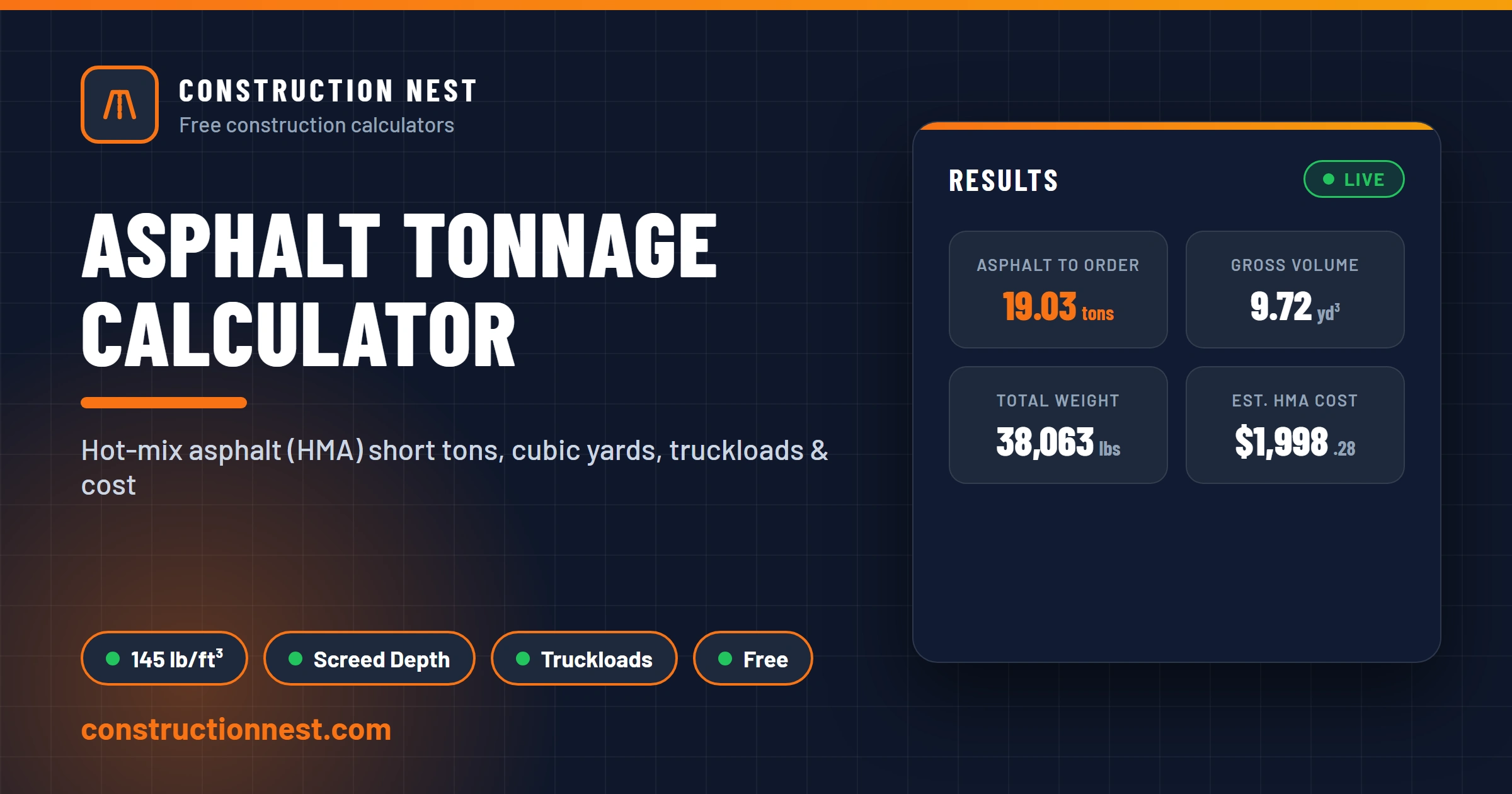
Use this free Asphalt Tonnage Calculator to calculate exact hot-mix asphalt (HMA) US short tons, cubic yards, loose paver screed depth, dump truck loads, and batch plant cost. Try the default: a 50 ft × 20 ft (1,000 sq ft) driveway paved to a 3-inch compacted depth (3.75 in loose screed) at 145 lbs/ft³ with +5% waste requires 19.03 US short tons (38,063 lbs / 9.72 yd³) and costs $1,998.28 in plant material at $105/ton.
It takes less than 30 seconds to calculate your hot-mix asphalt tonnage, compacted volume, loose screed setting, and dump truck loads.
Select Rectangle / Driveway for standard lanes and parking pads, Circle / Cul-de-Sac for round turnarounds, Total Area to enter square feet or square yards directly, or Road / Trench Patch for utility cuts.
Enter your paving length and width, then set your finished compacted asphalt depth (default 3 inches for new residential driveways, 2 inches for overlays, or 4 to 6 inches for heavy truck lots).
Keep the standard 145 lbs/ft³ (110 lbs/yd²/in) HMA density—or switch to Fine Surface Mix (140 lbs/ft³), Dense Base Course (150 lbs/ft³), or Cold-Patch (135 lbs/ft³)—and choose a +5% or +10% waste buffer.
Pick your dump truck payload capacity (default 20-ton tri-axle) and enter your local batch plant price per ton (default $105/ton).
Click Calculate Asphalt Tons to get your gross short tons, metric tonnes, loose screed depth, truckloads, and 50-lb bag equivalent. Copy the summary table or download the official A4 PDF report.
Ordering hot-mix asphalt (HMA) from a batch plant is unforgiving. Order two tons too little, and your paving crew sits idle while a cold joint forms across the middle of the driveway. Order four tons too much, and you pay $400+ for hot mix that hardens in the dump truck bed. Our Asphalt Tonnage Calculator converts your paving length, width, and compacted mat thickness into exact US short tons, cubic yards, loose screed depth, dump truck loads, and batch plant material cost.
Unlike basic volume calculators, this tool is built around real paving physics. Hot-mix asphalt is careful by volume on the ground (square feet times compacted depth), but it is sold purely by weight in US short tons (2,000 lbs) at the asphalt plant scale. Even more major, hot asphaltfluffs up in the paver hopper and compresses by 20% to 25% under a vibratory steel-wheel roller. Our calculator reflexly computes both your furled compacted thickness and the loose screed setting your crew needs on site.
Paving engineers and estimators use two equivalent mathematical approaches to calculate hot-mix asphalt tonnage. The first approach converts paving area and compacted depth into cubic feet and multiplies by unit density (145 lbs/ft³):
Compacted Volume (ft³) = Paving Area (sq ft) × (Compacted Depth in Inches ÷ 12)
Compacted Volume (yd³) = Compacted Volume (ft³) ÷ 27
Gross Asphalt Weight (US Short Tons) = [Compacted Volume (ft³) × Density (145 lbs/ft³) × (1 + Waste % ÷ 100)] ÷ 2,000
On highway and commercial jobs, estimators also use the classic 110-Pound Square-Yard Rule, which states that 1 square yard (9 sq ft) of compacted hot-mix asphalt weighs roughly 108.75 to 110 lbs per inch of thickness:
Asphalt Tons (Field Rule) = [Area in Square Yards × Compacted Depth in Inches × 110 lbs] ÷ 2,000
Finally, to set the height of the paving machine screed behind the auger before rolling, apply the 1.25× Loose Compaction Factor (1/4 inch of additional loose depth per 1 inch of ruined mat):
Loose Paver Screed Depth (in) = Target Compacted Depth (in) × 1.25
Here is the number-one error I see on residential and light-commercial paving jobs. A homeowner or new foreman orders enough asphalt for a 3-inch driveway, sets the paver screed to exactly 3.0 inches, and rolls it smooth. When they core-drill the ruined mat, it only measures 2.35 inches thick—and they have three tons of hot mix left sitting in the dump truck! Why? Because hot-mix asphalt comes out of the paver auger full of air voids (around 15% to 20% air). When a 3-to-5-ton vibratory double-drum roller makes its breakdown and finish passes, it squeezes the aggregate and liquid bitumen together until air voids drop to 6%–8%, compacting the mat by approximately 20% to 25% (1/4 inch per inch of depth).
Our calculator solves this reflexly. Because `145 lbs/ft³` is the already-compacted density of furled asphalt, scheming tonnage from your target 3.0-inch compacted depth gives you the exact weight of hot mix to buy at the plant—you merely instruct your screed operator to lay that tonnage at 3.75 inches loose so it rolls down to a true 3.0-inch structural mat.
Let us run the step-by-step numbers for our calculator’s default benchmark: a 50 ft long by 20 ft wide residential driveway (1,000 sq ft / 111.11 sq yd) paved to a 3-inch compacted thickness using standard 145 lb/ft³ hot-mix asphalt with a +5% waste buffer and a plant price of $105/ton:
If you want a complete turnkey installation estimate that includes excavation, crushed stone sub-base, paving crew labor, and sealcoating on top of raw HMA tonnage, plug your dimensions into our companion Asphalt Driveway Cost Calculator.
How many square feet does 1 US short ton (2,000 lbs) of hot-mix asphalt cover? At a compacted density of 145 lbs/ft³ (13.79 cubic feet per ton), 1 ton of asphalt covers 110.3 sq ft at 1.5 inches thick, 82.8 sq ft at 2 inches, 55.2 sq ft at 3 inches, 41.4 sq ft at 4 inches, or 27.6 sq ft at 6 inches. Use the master lookup table below (which includes a standard +5% waste factor) to estimate jobs on the spot:
| Paving Area (Sq Ft / Sq Yd) | 1.5″ Overlay (+5%) | 2.0″ Overlay (+5%) | 3.0″ Driveway (+5%) | 4.0″ Heavy Duty (+5%) | 6.0″ Commercial (+5%) |
|---|---|---|---|---|---|
| 200 sq ft (22.2 yd² • 1-Car Pad) | 1.90 tons (1.0 yd³) | 2.54 tons (1.3 yd³) | 3.81 tons (1.9 yd³) | 5.08 tons (2.6 yd³) | 7.61 tons (3.9 yd³) |
| 400 sq ft (44.4 yd² • 20’×20′ Pad) | 3.81 tons (1.9 yd³) | 5.08 tons (2.6 yd³) | 7.61 tons (3.9 yd³) | 10.15 tons (5.2 yd³) | 15.23 tons (7.8 yd³) |
| 640 sq ft (71.1 yd² • 40’×16′ 2-Car) | 6.09 tons (3.1 yd³) | 8.12 tons (4.1 yd³) | 12.18 tons (6.2 yd³) | 16.24 tons (8.3 yd³) | 24.36 tons (12.4 yd³) |
| 1,000 sq ft (111.1 yd² • 50’×20′ Default) | 9.52 tons (4.9 yd³) | 12.69 tons (6.5 yd³) | 19.03 tons (9.7 yd³) | 25.38 tons (13.0 yd³) | 38.06 tons (19.4 yd³) |
| 1,500 sq ft (166.7 yd² • 3-Car / Lane) | 14.27 tons (7.3 yd³) | 19.03 tons (9.7 yd³) | 28.55 tons (14.6 yd³) | 38.06 tons (19.4 yd³) | 57.09 tons (29.2 yd³) |
| 2,500 sq ft (277.8 yd² • Long Drive) | 23.79 tons (12.2 yd³) | 31.72 tons (16.2 yd³) | 47.58 tons (24.3 yd³) | 63.44 tons (32.4 yd³) | 95.16 tons (48.6 yd³) |
| 5,000 sq ft (555.6 yd² • Parking Lot) | 47.58 tons (24.3 yd³) | 63.44 tons (32.4 yd³) | 95.16 tons (48.6 yd³) | 126.88 tons (64.8 yd³) | 190.31 tons (97.2 yd³) |
When you call a local asphalt plant to place an order, the dispatcher won’t just ask how many tons you want—they will ask which nominal maximum aggregate size (NMAS) mix you need. According to pavement engineering rules from the Federal Highway Administration (FHWA) Asphalt Pavement Program, the compacted thickness of any single asphalt lift should be at least 3 times the nominal maximum aggregate stone size so the stones can rotate and lock together under the roller without crushing.
Furthermore, material density tables from the U.S. Environmental Protection Agency (EPA) Volume-to-Weight Conversion Guide show why loose vs. compacted asphalt densities differ so dramatically across mix designs:
| Asphalt Mix Type (Superpave / DOT Spec) | Max Stone Size | Compacted Density | Recommended Lift Depth | 2026 Plant Price ($/Ton) | Best Paving Application |
|---|---|---|---|---|---|
| 9.5mm Fine Surface / Topping Mix | 3/8 inch (9.5 mm) | 140 – 143 lbs/ft³ | 1.25″ to 2.0″ compacted | $105 – $125 / ton | Resurfacing overlays, tennis courts & smooth top wearing courses |
| 12.5mm Standard Surface / Driveway Mix | 1/2 inch (12.5 mm) | 145 lbs/ft³ (Default) | 2.0″ to 3.0″ compacted | $95 – $115 / ton | Single-lift residential driveways, parking stalls & road patching |
| 19.0mm Dense-Graded Binder / Base Mix | 3/4 inch (19.0 mm) | 148 – 150 lbs/ft³ | 2.5″ to 4.0″ compacted | $85 – $105 / ton | Structural bottom base layer under two-lift driveways & truck lanes |
| Cold-Patch / Cutback Pothole Mix | 1/4″ to 3/8″ chip | 130 – 135 lbs/ft³ | 1.0″ to 2.0″ tamped | $140 – $180 / ton ($16/bag) | Winter pothole repairs & narrow utility trench patches |
If your project takes excavating weak clay and installing a 6-to-8-inch compacted crushed aggregate base before the asphalt trucks arrive, calculate your stone base singly using our Gravel Driveway Calculator and Cubic Yard Calculator.
Timing your dump truck dispatch is vital because hot-mix asphalt leaves the plant silo at 285°F to 325°F and must receive its first breakdown roller pass before the mat cools below 240°F (and final finish rolling before 175°F). If you order 40 tons on a cool 55°F morning in two trucks that arrive meanwhile, the second truckload can crust over before your crew finishes raking the first load.
| Hauling / Packaging Approach | Usual Payload Capacity | Volume Equivalent (@ 145 lb/ft³) | Coverage @ 3″ Compacted Depth | Ideal Job Size |
|---|---|---|---|---|
| 50-lb Cold-Patch Bag (1 Pallet = 56 Bags) | 0.025 tons (50 lbs) | 0.37 ft³ (per bag) | 1.5 sq ft per bag (84 ft²/pallet) | Potholes & small utility cuts under 50 sq ft |
| Single-Axle Dump Truck | 6 to 8 short tons | 3.1 to 4.1 yd³ | 330 to 440 sq ft | Driveway aprons, turnouts & tight alleys |
| Tandem-Axle Dump Truck (10-Wheeler) | 13 to 15 short tons | 6.7 to 7.7 yd³ | 715 to 825 sq ft | Standard 2-car residential driveways (600–800 ft²) |
| Tri-Axle Dump Truck (Default) | 18 to 22 short tons | 9.2 to 11.3 yd³ | 990 to 1,210 sq ft | Full 1,000+ sq ft driveways & commercial pads |
| Semi End-Dump / Horizontal Flow-Boy | 24 to 28 short tons | 12.3 to 14.3 yd³ | 1,320 to 1,540 sq ft | Highway paving & parking lots (watch overhead wires!) |

At a standard 3-inch compacted thickness (using 145 lbs/ft³ hot-mix asphalt), a 1,000-square-foot driveway requires 18.13 net US short tons (36,250 lbs / 9.26 yd³), or 19.03 US short tons (38,063 lbs / 9.72 yd³) with a standard +5% waste buffer. For a 2-inch resurfacing overlay on 1,000 sq ft, order 12.69 short tons (+5% waste).
One US short ton (2,000 lbs) of compacted hot-mix asphalt at 145 lbs/ft³ equals 13.79 cubic feet and covers approximately 110 sq ft at 1.5 inches thick, 82.8 sq ft at 2 inches thick, 55.2 sq ft at 3 inches thick, 41.4 sq ft at 4 inches thick, or 27.6 sq ft at 6 inches thick.
Convert your paving area and compacted depth into cubic feet, multiply by 145 lbs/ft³, and divide by 2,000 lbs: Tons = [Length (ft) × Width (ft) × (Depth in Inches ÷ 12) × 145] ÷ 2,000. Alternatively, use the square-yard field rule: Tons = (Area in Sq Yd × Depth in Inches × 110 lbs) ÷ 2,000.
At the batch plant gate (FOB), standard hot-mix asphalt costs between $85 and $125 per US short ton (averaging $105/ton nationwide). For a 1,000 sq ft driveway requiring 19.03 tons at 3 inches deep, raw HMA plant material costs approximately $1,998.28 ($2.00/sq ft) before hauling and paving labor.
Hot-mix asphalt compacts by approximately 20% to 25% (about 1/4 inch per inch of thickness) under a vibratory steel-wheel roller. To achieve a true 3.0-inch compacted driveway mat, set the paver screed to 3.75 inches loose depth; for a 2.0-inch compacted overlay, set the screed to 2.50 inches loose.