Building a block wall? Guessing how many blocks you need can cost you money or time. Our concrete block calculator gives you a clear count in seconds. For example, every 100 square feet of wall needs about 113 standard concrete blocks. Just enter your wall size, remove the openings, add a waste allowance, and get your number.
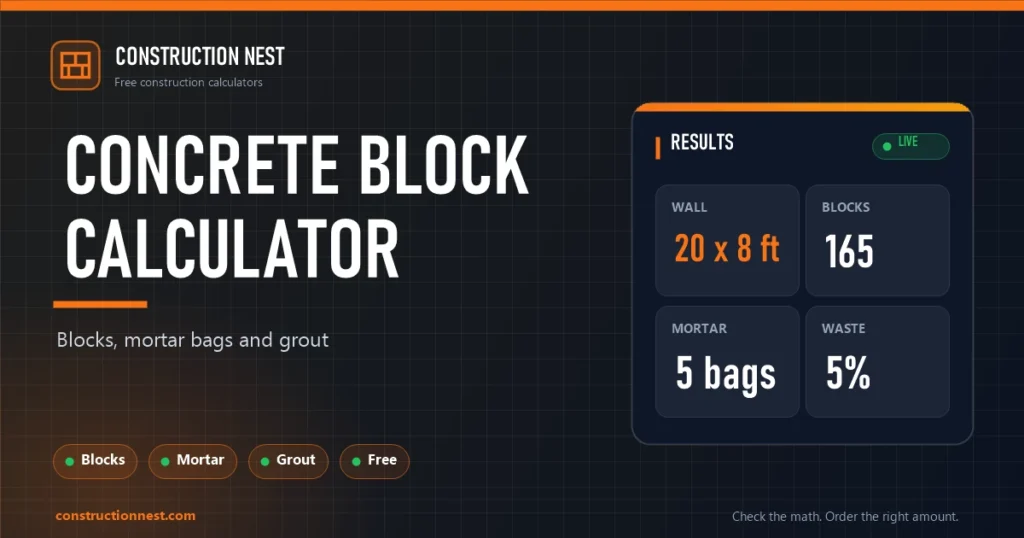
Using this concrete block calculator takes about a minute. Follow these steps in order.
Choose Wall Dimensions (L × H) if you know the length and height. Choose Total Wall Surface Area if you already know the square feet. The tool starts with a 20 ft long and 8 ft high wall, which is 160 square feet.
Type the length and height. You can use feet and inches, feet only, inches, meters, or meters and centimeters. In area mode, pick square feet or square meters.
The default is the standard 8-inch CMU, which is 8 × 8 × 16 inches nominal. You can also pick 4, 6, 10, or 12 inches. If your block is an odd size, choose Custom and type its height and length.
Most walls use a 3/8-inch joint, so that is the default. The tool adds the joint to the block size. That is why each standard block covers about 0.89 square feet of wall, not a full 1 square foot.
I use 5% for a simple straight wall. For a wall with many corners or cuts, I go up to 10%. You can also pick 15%, 0%, or type your own number.
Type how many doors and windows you have. The tool takes off 21 square feet for each door (3 × 7 ft) and 16 square feet for each window (4 × 4 ft). If yours are bigger, use Total Area mode and subtract them yourself.
Under Core Fill & Rebar, choose full grout, partial grout, or loose insulation fill. You can also set wire mesh and vertical rebar spacing. Under Material Pricing, enter your local prices to get a cost.
With the default numbers, you get 189 blocks with waste and about 6 bags of 80 lb mortar mix. You also see grout volume, rebar, and cost if you filled them in.
After the first calculation, the results update live as you edit any box. Try switching from 5% to 10% waste and watch the count move. Then copy the summary, download a PDF, or share it with your mason or supplier.
Not sure which block size or grout option fits your wall? Tell me your wall size in the comments, and I’ll help you pick.
The calculator does three small jobs. It finds your wall area, then it finds how much wall one block covers. Last, it divides and adds extra for waste.
First comes the area. It multiplies wall length by wall height, then takes away your openings. A 20 ft × 8 ft wall is 160 square feet, and one door takes off 21 square feet. That leaves 139 square feet.
Net Wall Area = Wall Length × Wall Height – Openings
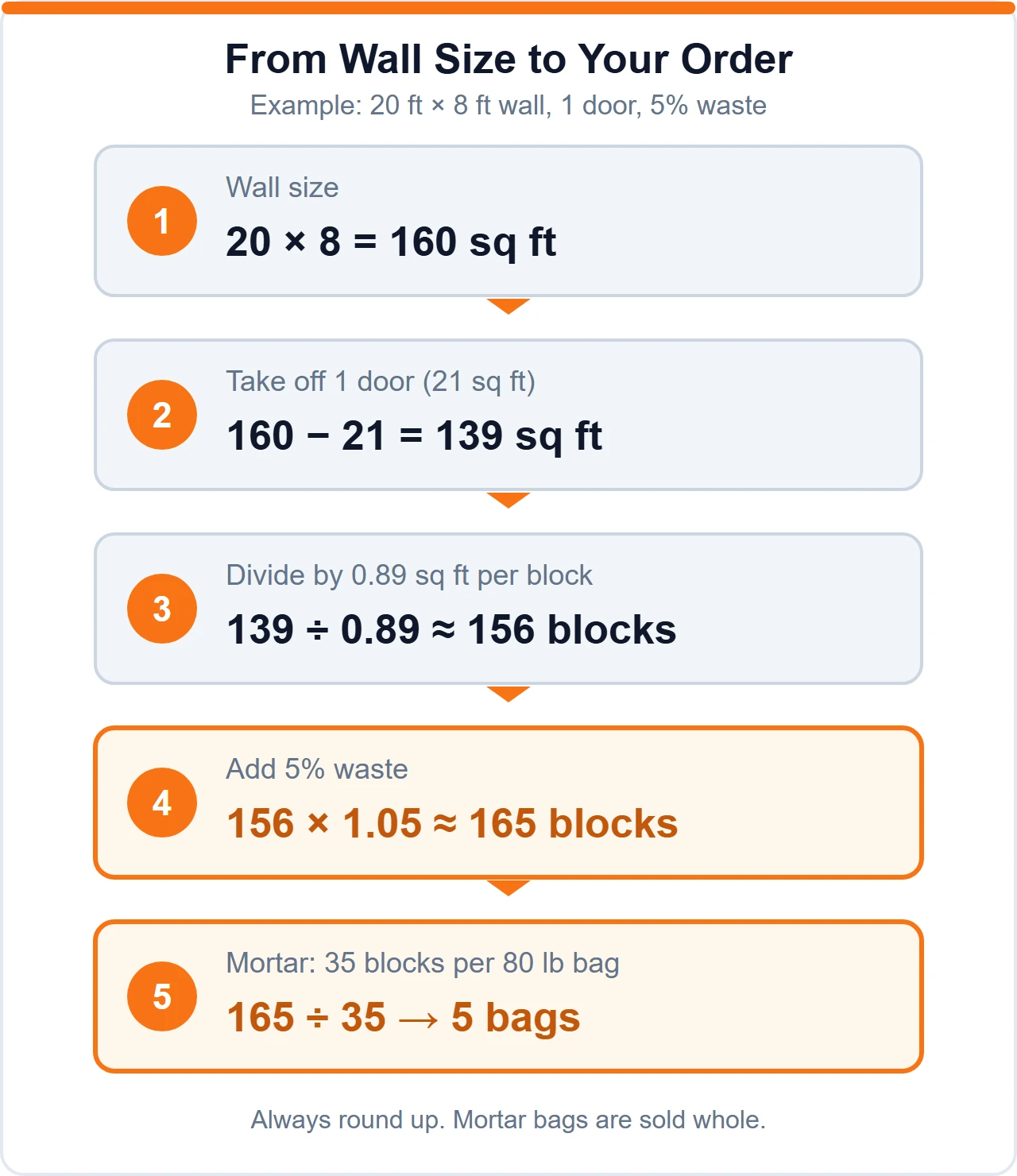
Next is the block. A standard 8-inch CMU is called 8 × 8 × 16. That is its nominal size, the name you see on an order sheet. The actual block is a bit smaller, about 7⅝ × 7⅝ × 15⅝ inches.
The missing ⅜ inch is room for the mortar joint. So the tool adds the joint back. One block plus its joint covers 16 × 8 inches, which is about 0.89 square feet. That is why one block does not cover a full square foot.
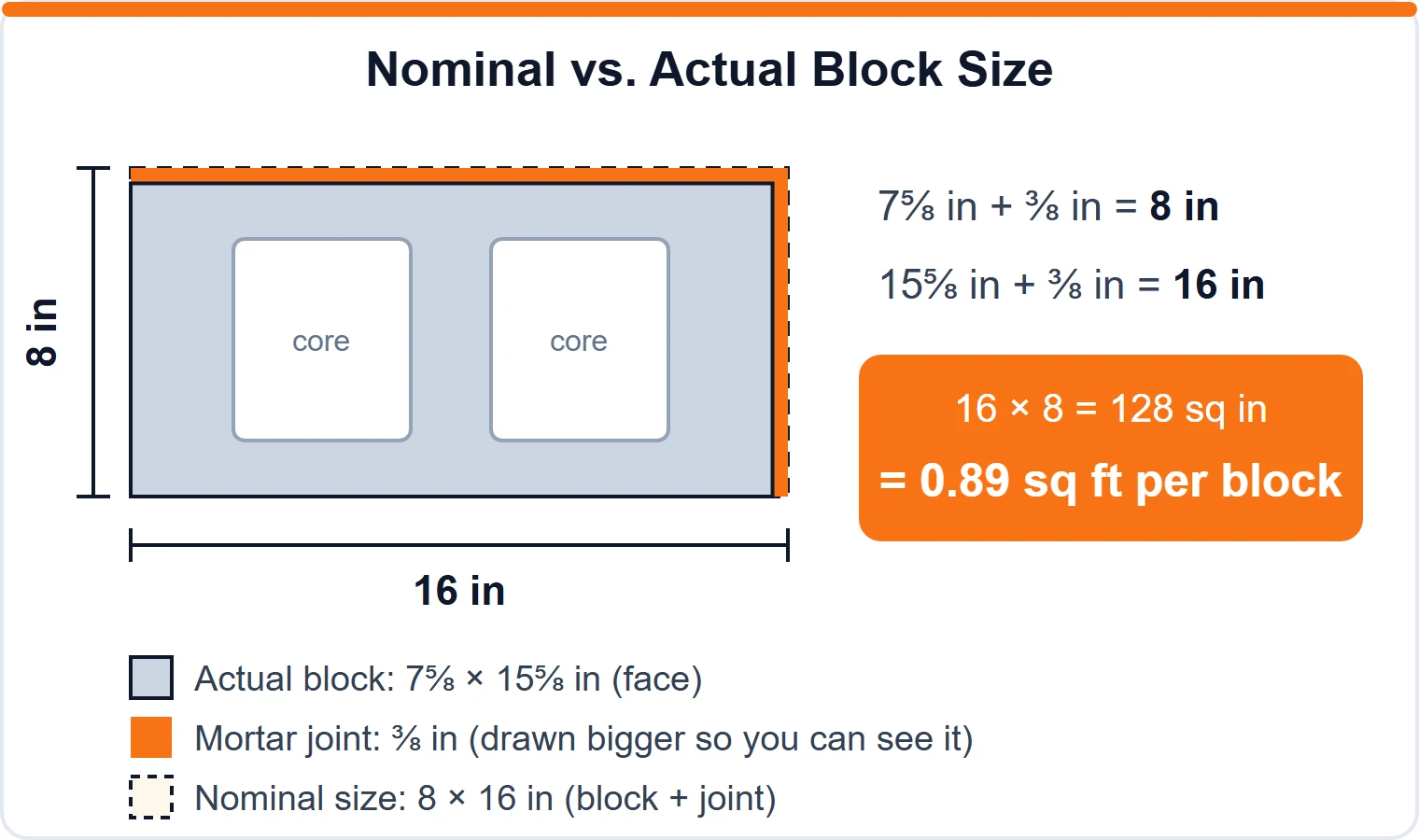
For our 139 square foot wall, that gives about 156 blocks. Then the waste allowance is added. At 5%, the total is 165 blocks.
Many charts just say “one block per square foot” and stop there. I don’t like that, because it skips the joint and the waste, and that is where short orders start.
Last spring, a friend of mine started a 24 ft long garden wall that was 4 ft high. He used the one-block-per-square-foot rule and ordered 96 blocks. The real math says 108 blocks before waste, so he was 12 blocks short on day one.
He called me, and we ran the numbers together. He had to make a second trip to the yard, and it cost him half a day. If your wall has many corners or cuts, change the waste to 10% and watch the count move.
In my professional experience, I’ve found that people think a thicker block means more blocks to buy. It does not. Every common concrete block has the same 8 × 16 inch face. Only the thickness changes.
That means a 100 square foot wall needs about 113 blocks in any size below. With 5% waste, it is about 119 blocks.
| Nominal Size (T × H × L) | Actual Size (inches) | Blocks per 100 sq ft | With 5% Waste | Common Use |
|---|---|---|---|---|
| 4 × 8 × 16 | 3⅝ × 7⅝ × 15⅝ | 113 | 119 | Partition and garden walls |
| 6 × 8 × 16 | 5⅝ × 7⅝ × 15⅝ | 113 | 119 | Light walls |
| 8 × 8 × 16 | 7⅝ × 7⅝ × 15⅝ | 113 | 119 | Most walls and foundations |
| 10 × 8 × 16 | 9⅝ × 7⅝ × 15⅝ | 113 | 119 | Taller walls |
| 12 × 8 × 16 | 11⅝ × 7⅝ × 15⅝ | 113 | 119 | Foundations and heavy loads |
Thickness still matters for your build. It changes the weight, the cost, and how much grout fits inside the cores. The 8-inch block is the one I see most on job sites.
You can check the height by counting courses. Each course is 8 inches tall with its joint, so an 8 ft wall is 12 courses. Length works the same way, because each block plus joint is 16 inches long. A 20 ft wall holds 15 blocks in each course.
Corner blocks, half blocks, and bond beam units are special units. Count them separately and take them out of your main total. Block sizes also change a little between makers, so check your supplier’s spec sheet. Using a size I did not list? Pick Custom in the calculator.
Mortar is the easy part. The calculator counts 35 blocks for each 80 lb bag of mortar mix. I always round up by one bag, because mixed mortar gets hard if it sits too long.
So 100 blocks need 3 bags, and 1,000 blocks need about 29 bags. The 165-block wall from above needs 5 bags.
I learned the hard way not to mix it all at once. On one of my first jobs, I mixed mortar for the whole afternoon in one go. By the time I reached the last rows, the batch had turned stiff, and I threw a lot of it away.
Now I mix one bag at a time. One bag lays about 35 blocks, which is a little over 2 courses on a 20 ft wall. That pace keeps the mortar fresh and the joints neat.
Hollow block has open spaces inside called cores. You fill them with grout only where your plan says so, often around rebar. Filling every core adds strength, but it adds cost too.
If you fill every core, 100 8-inch blocks take about 24 cubic feet of grout. That is about 0.9 cubic yard, or roughly 40 bags of 80 lb premix at 0.6 cubic feet per bag. Fill half the cores and it drops to about 12 cubic feet, or 20 bags.
Rebar goes inside the filled cores. With bars every 32 inches, a 20 ft wall needs 8 vertical bars.
These are estimates, because core size changes from one maker to another. I add 5% to 10% extra grout to be safe. If your numbers look far off, send me your wall size and we can check them together.
I’ve seen this pattern many times in my work. The wall math is right, but the order still comes up short. These are the five slips I see most.
The dust one hit close to home for me. I once watched a helper cut block with a dry angle grinder inside a closed garage. In under 5 minutes, the air looked like fog.
We stopped, opened every door, and moved the cutting outside to a wet saw. It cost us a few minutes, but I would take that trade every time. Have you made one of these slips before? I’d love to hear your story in the comments.
A good block order comes down to four things: the right wall area, the real block size, a fair waste number, and whole bags of mortar. Get those right and you will not need a second trip to the yard.
Run your wall through the calculator above, then check it once by hand. If your wall has odd shapes, steps, or a lot of openings, send me the sizes and we can look at them together.

First, find the net wall area. Multiply the wall length by the wall height, then take off doors and windows. Next, divide by 0.89 square feet, which is the area one standard 8 × 8 × 16 block covers with a 3/8-inch joint. Last, add 5% to 10% for waste. A 20 ft × 8 ft wall is 160 square feet, which needs 180 blocks, or 189 with 5% waste. The calculator above does all of this for you.
You need about 29 bags of 80 lb mortar mix for 1,000 blocks. The calculator counts 35 blocks per bag. If you order 5% extra blocks, that is 1,050 blocks, which is about 30 bags. If you mix cement and sand yourself, the bag count changes with your mix, so ask your supplier for the ratio.
If you fill every core, 100 standard 8-inch blocks take about 24 cubic feet of grout, or 0.9 cubic yard. That is roughly 40 bags of 80 lb premix. Fill half the cores and you need about 12 cubic feet, or 20 bags. Fill one third and you need about 8 cubic feet, or 13 bags. Add 5% to 10% extra to be safe.
One 80 lb bag makes about 0.6 cubic feet. A standard 8-inch block holds about 0.24 cubic feet when every core is filled. So one bag fills about 2 to 3 blocks. True cinder blocks are rare today, but the math works the same for modern concrete blocks (CMU).
I use 5% for a simple straight wall. For a wall with many corners, cuts, or openings, I use 10%. If the crew is new or the layout is tricky, 15% is safer. On a 1,000-block order, each step adds 50 blocks. You can change the waste box in the calculator and watch the total update.