
Calculate pea gravel cubic yards, short tons, 50 lb bags, and cost.
Use this free Pea Gravel Calculator to find out how many cubic yards, short tons, and 50 lb bags of stone your patio, walkway, or garden bed needs. Try the default: a 12 ft × 10 ft patio (120 sq ft) at a 3-inch depth with 10% waste requires 33.00 cubic feet (1.22 cubic yards), which weighs 3,300 lbs (1.65 tons) or takes 66 bags (0.5 cu ft each).
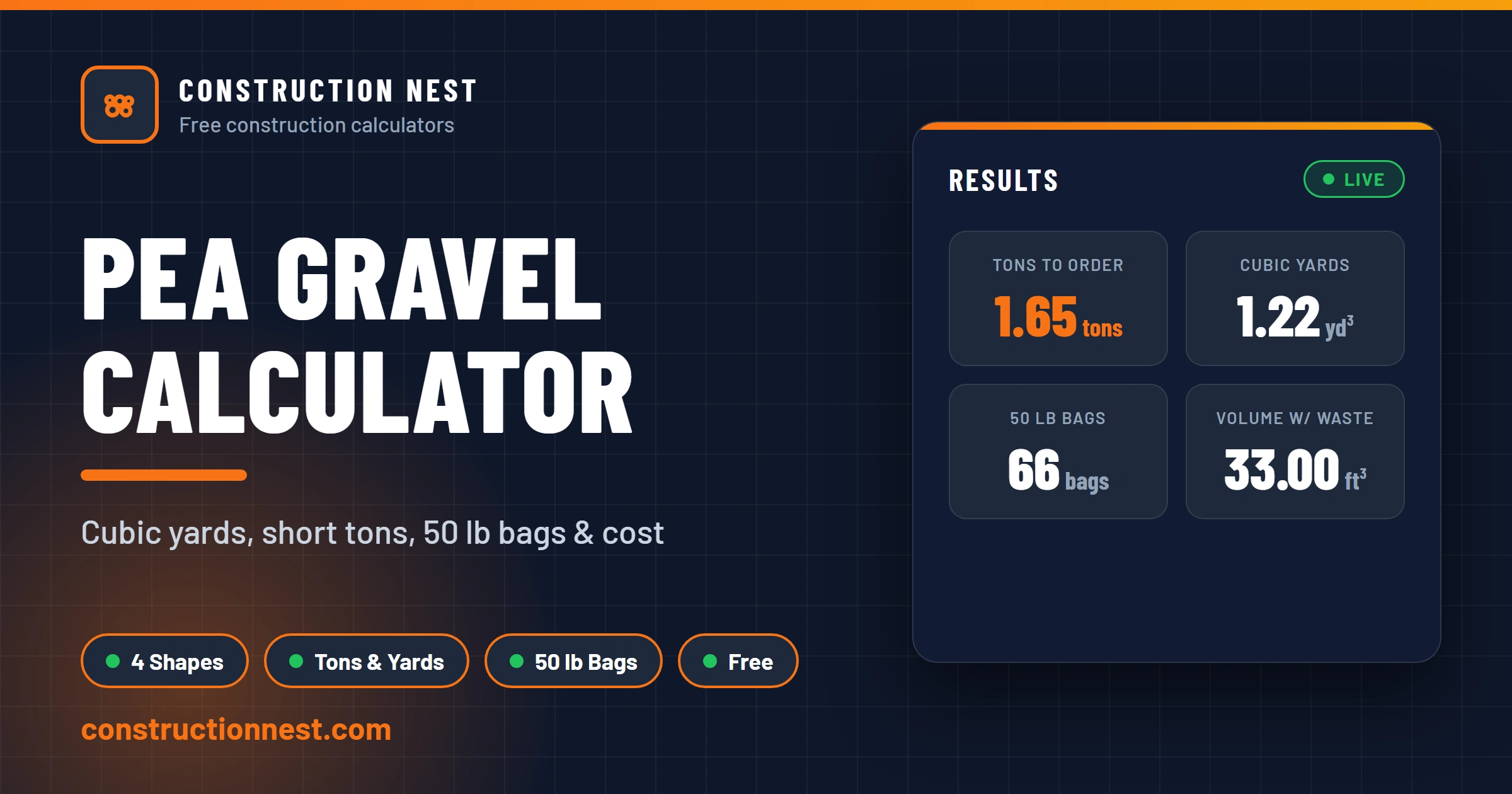
It takes less than 30 seconds to calculate your gravel volume, tonnage, and bag count.
Select Rectangle / Path for standard beds and walkways, Circle / Fire Pit for round seating pads, Total Area if you already know your square footage, or Triangle Bed for corner beds.
Type your length, width (or diameter), and gravel depth in inches or feet. The default is a 12 ft × 10 ft bed at 3 inches deep.
Select your pea gravel density (default 100 lb/ft³ dry gravel, 95 lb/ft³ loose, or 105 lb/ft³ damp) and a waste % (10% recommended for grading and settling).
Pick your retail bag size (0.5 cu ft / ~50 lb default) and optionally add your local price per ton and delivery fee.
Click Calculate Pea Gravel to see your tons, cubic yards, bags, and total cost. Copy the summary table or download the official A4 PDF takeoff sheet.
Use our Pea Gravel Calculator to find out how many cubic yards, short tons, and 50 lb bags of stone your yard project needs. Small rounded stones pack differently than flat pavers or wood mulch. Guessing the depth by eye often leaves you short by half a truckload or stuck with heavy bags left over on your driveway.
Whether you are building a backyard patio, a garden walkway, a dog run, or a French drain trench, this Pea Gravel Calculator handles rectangular beds, circular fire pits, triangles, and total square footage. It converts your measurements into exact gravel volume and weight so you can compare bulk delivery prices against bagged materials before you place an order.
Every pea gravel takeoff starts with surface area and depth. You measure your bed length and width in feet, multiply them together to get square feet, and then multiply that by the stone depth converted from inches into feet. If you want to explore more tools for outdoor hardscapes, visit our landscaping calculators hub.
Here is the exact step-by-step math our Pea Gravel Calculator runs behind the scenes. First, find the surface area of your rectangular bed or walkway:
Area (sq ft) = Length (ft) × Width (ft)
If you’re filling a round fire pit patio, the tool uses the circle diameter instead. It divides your diameter by 2 to get the radius, squares that radius, and multiplies by 3.1416:
Circle Area (sq ft) = 3.1416 × (Diameter (ft) ÷ 2)²
Next, convert your gravel depth from inches into feet by dividing by 12 inches per foot, and multiply that by the area to get net volume in cubic feet:
Net Volume (cu ft) = Area (sq ft) × (Depth (in) ÷ 12)
Bulk stone suppliers sell pea gravel by the cubic yard or by the US short ton. Since a cube measuring 3 feet on every side holds 27 cubic feet, our Pea Gravel Calculator divides your cubic feet by 27 to get net yards:
Net Cubic Yards (yd³) = Net Volume (cu ft) ÷ 27
Next, add a settling and grading allowance (normally 10%) so low spots in your soil base do not leave thin patches:
Volume with Waste (cu ft) = Net Volume (cu ft) × (1 + Waste % ÷ 100)
To convert volume into weight, multiply total cubic feet by the bulk density of dry pea gravel (100 lbs per cubic foot, or 2,700 lbs per cubic yard) and divide that by 2,000 lbs per short ton:
Weight to Order (Tons) = (Volume with Waste (cu ft) × Density (lb/ft³)) ÷ 2,000
Finally, if you’re buying standard retail 50 lb bags at a garden center, each bag holds 0.5 cubic feet of stone. Divide your total cubic feet by 0.5 and round up to the next whole bag:
50 lb Bags Needed = Volume with Waste (cu ft) ÷ 0.5
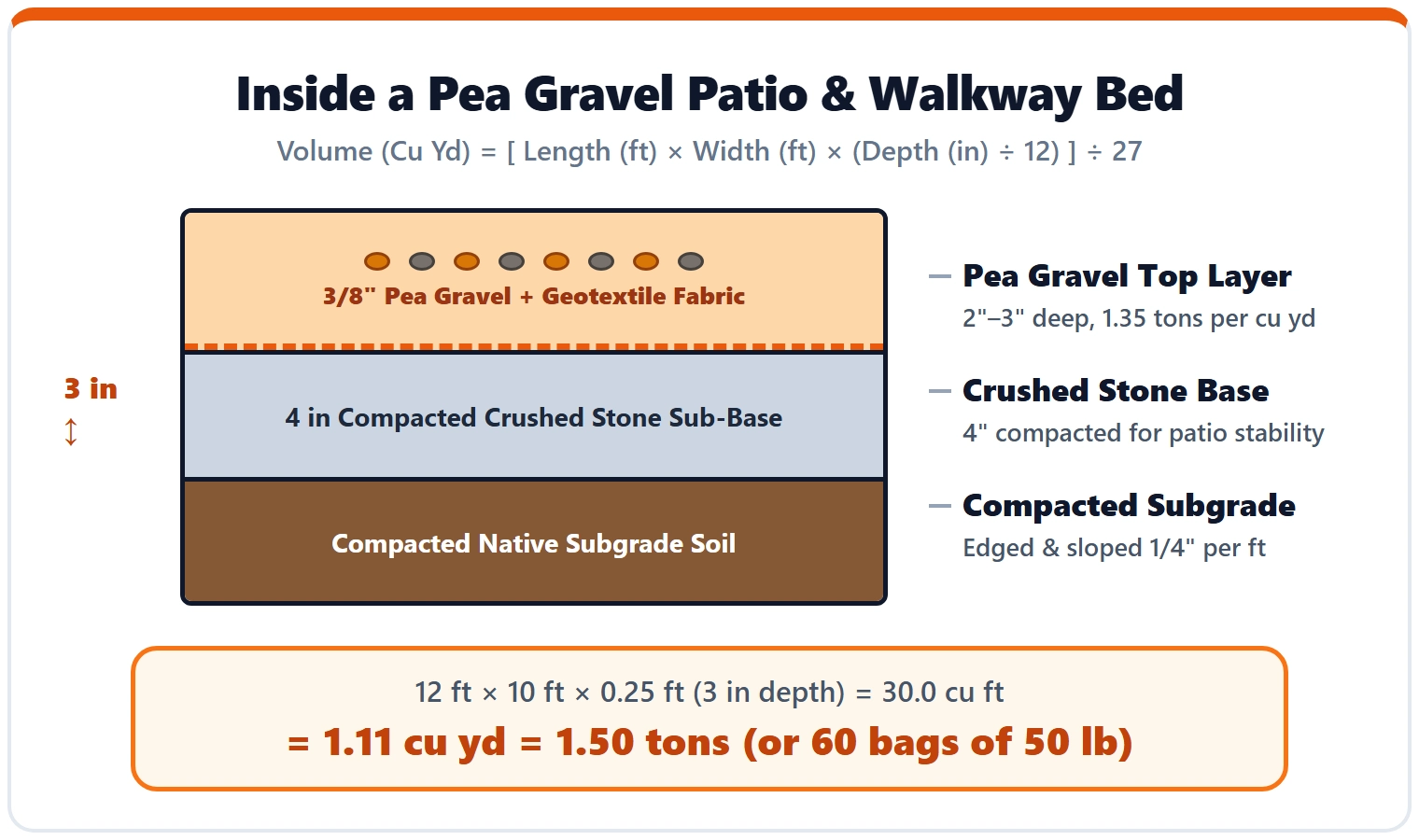
In my professional experience, I have found that forgetting to divide inch depth by twelve is the number one reason DIY orders come up wrong. Let us walk through the default project in our Pea Gravel Calculator so you can check your own math by hand.
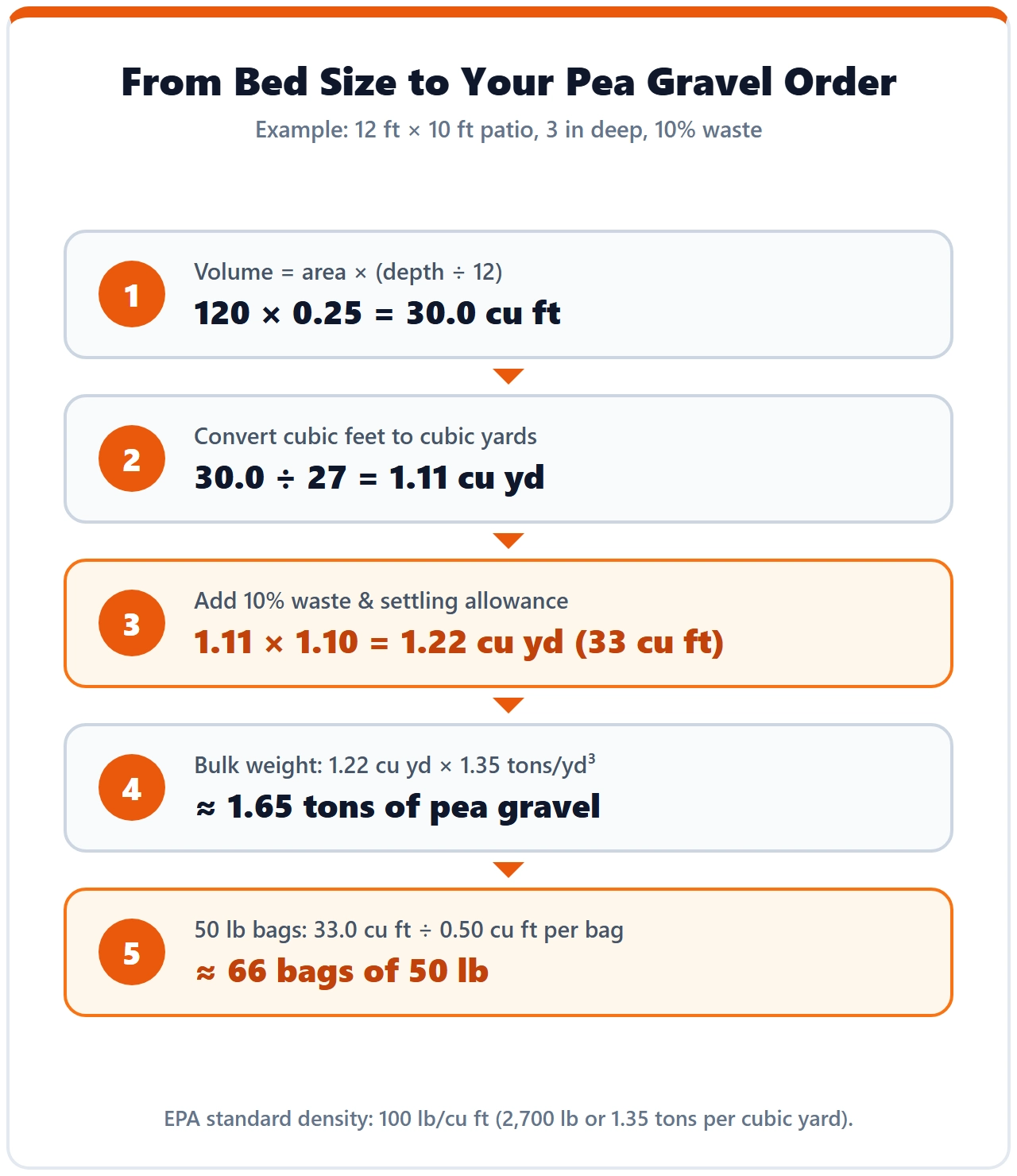
Suppose you are installing a 12 ft by 10 ft backyard seating patio filled with 3 inches of dry pea gravel, and you add a 10% allowance for settling and raking. First, multiply 12 ft × 10 ft to get a surface area of 120.00 sq ft.
Second, convert the 3-inch depth into feet: 3 ÷ 12 = 0.25 ft. Multiply 120.00 sq ft × 0.25 ft to get a net volume of 30.00 cubic feet. Dividing 30.00 ÷ 27 gives 1.11 cubic yards net.
Third, apply the 10% waste factor: 30.00 × 1.10 = 33.00 cubic feet, which equals 1.22 cubic yards (0.93 m³) to order. At the standard dry bulk density of 100 lbs per cubic foot, your patio stone weighs 3,300 lbs, or 1.65 US short tons.
If you buy bagged stone instead of bulk delivery, divide 33.00 cu ft ÷ 0.5 cu ft per bag to get 66 bags. When you enter a local stone yard price of $55 per ton plus a flat $75 dump delivery fee into the Pea Gravel Calculator, your total material and delivery estimate comes to $165.75 (1.65 × $55 = $90.75 plus $75.00).
What if you’re building a round 12-foot diameter fire pit area at the same 3-inch depth? The radius is 6 ft, so the area is 3.1416 × 36 = 113.10 sq ft, needing 28.27 cu ft net or 31.10 cu ft (1.15 cubic yards / 1.56 tons / 63 bags) with 10% waste. Before you order your perimeter steel or plastic border strips, run your patio dimensions through our linear feet calculator so you buy the exact edging footage.
| Project Area | Depth | Net Volume (ft³ / yd³) | Order Volume (+10% Waste) | Order Weight (Tons @ 100 lb/ft³) | 50 lb Bags (0.5 ft³) |
|---|---|---|---|---|---|
| 50 sq ft (5×10 Walkway) | 2 in | 8.33 ft³ (0.31 yd³) | 9.17 ft³ (0.34 yd³) | 0.46 tons (917 lbs) | 19 bags |
| 50 sq ft (5×10 Walkway) | 3 in | 12.50 ft³ (0.46 yd³) | 13.75 ft³ (0.51 yd³) | 0.69 tons (1,375 lbs) | 28 bags |
| 100 sq ft (10×10 Patio) | 2 in | 16.67 ft³ (0.62 yd³) | 18.33 ft³ (0.68 yd³) | 0.92 tons (1,833 lbs) | 37 bags |
| 100 sq ft (10×10 Patio) | 3 in | 25.00 ft³ (0.93 yd³) | 27.50 ft³ (1.02 yd³) | 1.38 tons (2,750 lbs) | 55 bags |
| 100 sq ft (10×10 Patio) | 4 in | 33.33 ft³ (1.23 yd³) | 36.67 ft³ (1.36 yd³) | 1.83 tons (3,667 lbs) | 74 bags |
| 120 sq ft (10×12 Patio) | 3 in | 30.00 ft³ (1.11 yd³) | 33.00 ft³ (1.22 yd³) | 1.65 tons (3,300 lbs) | 66 bags |
| 200 sq ft (10×20 Dog Run) | 3 in | 50.00 ft³ (1.85 yd³) | 55.00 ft³ (2.04 yd³) | 2.75 tons (5,500 lbs) | 110 bags |
| 400 sq ft (20×20 Courtyard) | 3 in | 100.00 ft³ (3.70 yd³) | 110.00 ft³ (4.07 yd³) | 5.50 tons (11,000 lbs) | 220 bags |
Picking the right stone depth in our Pea Gravel Calculator is a balance between weed control and walking comfort. Because natural river-run pea gravel consists of smooth, water-worn stones approximately 1/4 inch to 3/8 inch wide, the pebbles roll against each other instead of locking tightly like crushed limestone or angular granite.
According to a master gardener field guide published by the University of California Agriculture and Natural Resources (UC ANR), 2 inches is the practical minimum depth for garden gravel pathways, while 4 inches is needed when thick stepping stones or pavers are set into the bed. Their extension guidance also notes that 1 ton of gravel covers around 80 to 120 square feet at a 2-inch depth (at 100 lb/ft³, 1 ton = 20 cu ft, which covers/fills 120 sq ft net at 2 inches or 80 sq ft net at 3 inches).
If you pour rounded pea gravel deeper than 3 inches on a foot path, your shoes sink like walking on dry beach sand. For a rock-solid patio or parking pad, spread a 4-inch compacted crushed-stone base first and top it with just 1.5 to 2 inches of decorative pea gravel. If you’re comparing a gravel pad against a poured concrete patio, check our concrete slab cost calculator to compare sub-base and concrete prices side by side.
| Application | Recommended Depth | Coverage per Ton (Net) | Coverage per Cubic Yard (Net) | Weight per Sq Ft (@ 100 lb/ft³) |
|---|---|---|---|---|
| Decorative Mulch & Flower Beds | 2 inches | 120 sq ft / ton | 162 sq ft / yd³ | 16.67 lbs / sq ft |
| Garden Walkways & Foot Paths | 2.5 to 3 inches | 80 – 96 sq ft / ton | 108 – 130 sq ft / yd³ | 20.83 – 25.00 lbs / sq ft |
| Backyard Patios & Fire Pits | 3 inches | 80 sq ft / ton | 108 sq ft / yd³ | 25.00 lbs / sq ft |
| Dog Runs & Play Areas | 3 to 4 inches | 60 – 80 sq ft / ton | 81 – 108 sq ft / yd³ | 25.00 – 33.33 lbs / sq ft |
| Stepping Stone Beds & Drain Trenches | 4 to 6 inches | 40 – 60 sq ft / ton | 54 – 81 sq ft / yd³ | 33.33 – 50.00 lbs / sq ft |
I have seen this pattern many times in my work: a homeowner orders a single cubic yard of pea gravel thinking it weighs one ton, and then watches the loader drop almost a ton and a half of stone onto a light pickup axle. Understanding bulk density keeps your truck safe and your budget precise.
According to standard volume-to-weight conversion tables published by the U.S. Environmental Protection Agency (EPA), dry gravel weighs 100 lbs per cubic foot (2,700 lbs or 1.35 short tons per cubic yard), loose gravel weighs 2,565 lbs per cubic yard (95 lbs per cubic foot), and wet gravel weighs 100 to 120 lbs per cubic foot. Our Pea Gravel Calculator lets you switch between all three EPA-verified density presets or type in a custom quarry weight.
When should you switch from 50 lb retail bags to bulk dump delivery? One cubic yard equals 54 bags (at 0.5 cu ft each). Once your project exceeds 0.75 cubic yards (about 1 ton or 40 bags), ordering bulk stone by the ton typically saves 35% to 50% even after paying a local dump-truck delivery fee.
To keep your finished gravel bed neat for years, avoid three typical field errors. First, always install a rigid border of steel edging, masonry blocks, or timber ties so rounded pebbles cannot migrate into your lawn mower path; you can size block borders with our concrete block calculator or wood timber borders with our board foot calculator.
Second, lay heavy woven geotextile fabric over compacted soil before pouring stone. The fabric stops rounded pebbles from sinking into wet dirt while still letting rainwater drain freely. Ready to price out the rest of your yard build? Use the Pea Gravel Calculator above to download your PDF material takeoff sheet, and explore all of our free engineering tools on Construction Nest.

Multiply your length by width in feet to get square feet, multiply by depth in inches divided by 12 to get cubic feet, and divide by 27 for cubic yards. Multiply cubic yards by 1.35 to get US short tons (at 100 lb/ft³). For a 12×10 ft patio at 3 inches deep with 10% waste, order 1.22 cubic yards (1.65 tons or 66 bags).
One standard 50 lb bag of pea gravel holds 0.5 cubic feet and covers 3.0 sq ft at a 2-inch depth, 2.0 sq ft at a 3-inch depth, or 1.5 sq ft at a 4-inch depth. You need 54 bags of 0.5 cu ft to equal 1 cubic yard (27 cu ft).
A 10 ft ? 10 ft area (100 sq ft) at a 3-inch depth requires 0.93 cubic yards net, or 1.02 cubic yards (1.38 short tons / 55 bags) with 10% waste.
One cubic yard (27 cubic feet) of dry pea gravel weighs 2,700 lbs, or 1.35 US short tons, based on the U.S. EPA dry gravel bulk density of 100 lbs per cubic foot. Loose uncompacted gravel weighs 2,565 lbs (1.28 tons) per cubic yard.
Spread pea gravel 2 to 3 inches deep for walkways, garden beds, and patios, and 3 to 4 inches deep for dog runs or beds with embedded stepping stones. Pouring rounded pea gravel deeper than 3 inches on a walking path makes the surface feel loose and spongy underfoot.