Calculate pool volume in US gallons, liters, cubic feet, water weight, and hose fill time.
Use this free Pool Volume Calculator to find out how many US gallons, liters, and cubic feet of water your rectangular, round, oval, or kidney swimming pool holds. Try the default: a 16 ft × 32 ft in-ground rectangular pool (512 sq ft) sloping from a 3.5 ft shallow end to an 8.0 ft deep end (5.75 ft average depth) holds 2,944.00 cubic feet or 22,023 US gallons (83,365 liters), weighs 91.89 US tons, and takes 40.8 hours to fill at 9 GPM.
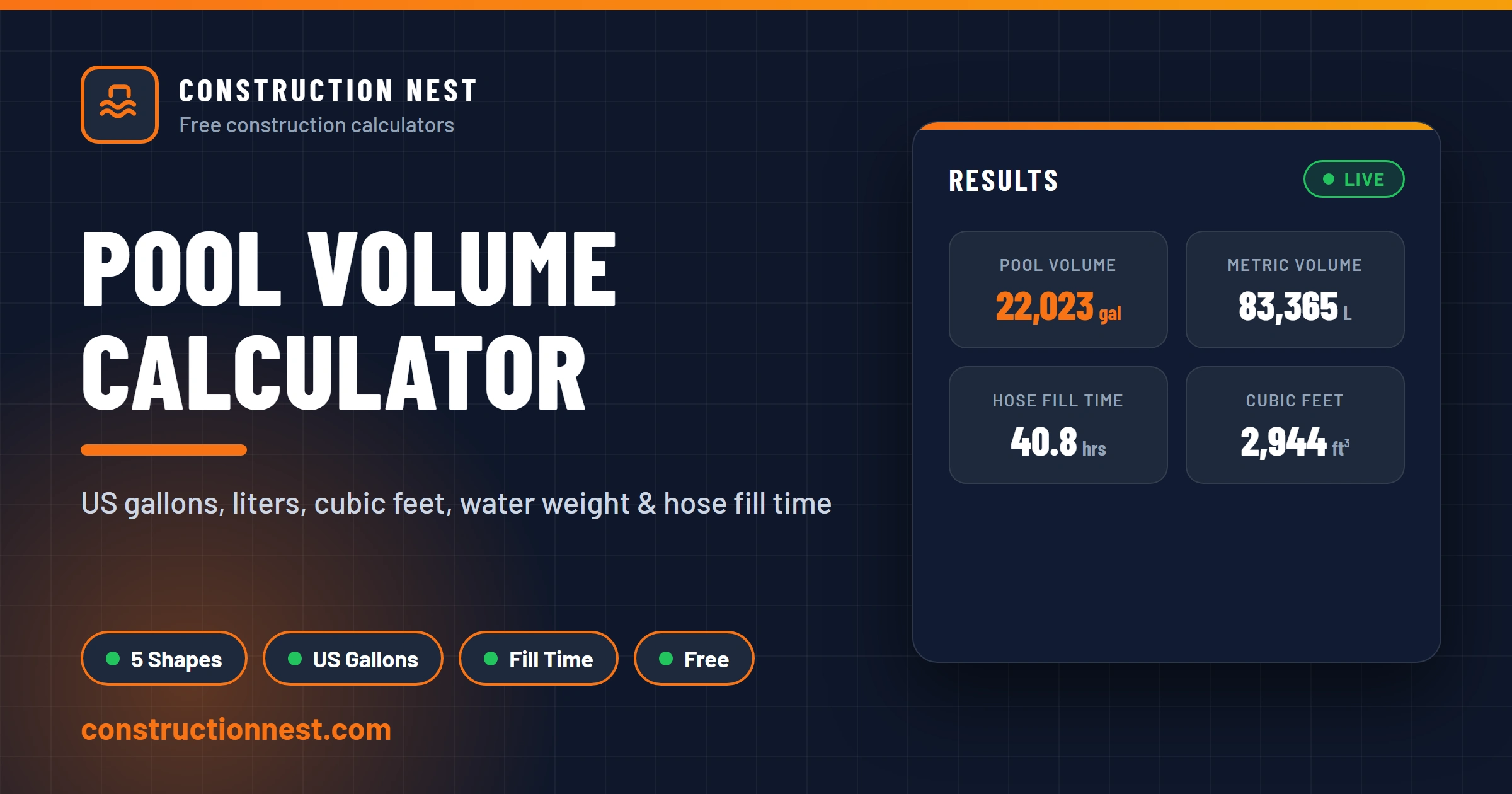
It takes less than 30 seconds to calculate your pool water volume in US gallons, liters, cubic feet, water weight, and garden hose fill time.
Select Rectangle for lap and family pools, Round for circular above-ground pools, Oval for oval basins, Kidney for curved freeform pools (uses the 0.45 × (Width A + Width B) × Length formula), or Surface Area if you already know your water square footage.
Type your pool’s inside length and width (or diameter) in feet, inches, yards, or meters. Measure from inside wall to inside wall at the waterline rather than outside the coping stones.
Enter your shallow end and deep end actual water depth (from the pool floor to the middle of the skimmer opening). For flat-bottom above-ground pools, type the same depth in both boxes.
Select your garden hose flow rate (default 9 GPM / 540 gal/hr), target pump filtration turnover (8 hours default), and optional water cost per 1,000 gallons.
Click Calculate Pool Volume to view your US gallons, liters, fill hours, pump GPM, and total water weight. Copy the summary table or download the official A4 PDF report.
Use this pool volume calculator to find the exact water capacity of your swimming pool in US gallons, liters, Imperial gallons, and cubic feet. To calculate pool volume in gallons, multiply your pool’s surface area in square feet by the average water depth (`(Shallow End + Deep End) ÷ 2`) to get cubic feet, then multiply that by 7.48052 US gallons per cubic foot. For a standard 16 ft × 32 ft rectangular in-ground pool averaging 5.75 feet deep, total water capacity is 22,023 US gallons (83,365 liters).
Every residential and commercial swimming pool is a three-dimensional water prism. Once you measure out the surface area of the water and the average depth from the pool floor to the middle of the skimmer opening, converting cubic feet into liquid gallons uses exact physical constants: 1 cubic foot equals 7.48052 US gallons (28.3168 liters), and 1 US gallon of fresh water weighs 8.345 pounds.
Average Water Depth (ft) = (Shallow End Depth + Deep End Depth) ÷ 2
After finding your average depth, multiply your pool’s surface area by the average depth and the 7.48052 gal/ft³ conversion factor using the exact shape formula for your basin:
Rectangular Pool Volume (US Gallons) = Length (ft) × Width (ft) × Average Depth (ft) × 7.48052
Round Pool Volume (US Gallons) = 3.1416 × (Diameter ÷ 2)² × Average Depth (ft) × 7.48052
Oval Pool Volume (US Gallons) = 3.1416 × (Length ÷ 2) × (Width ÷ 2) × Average Depth (ft) × 7.48052
Kidney Pool Volume (US Gallons) = 0.45 × (Width A + Width B) × Length (ft) × Average Depth (ft) × 7.48052
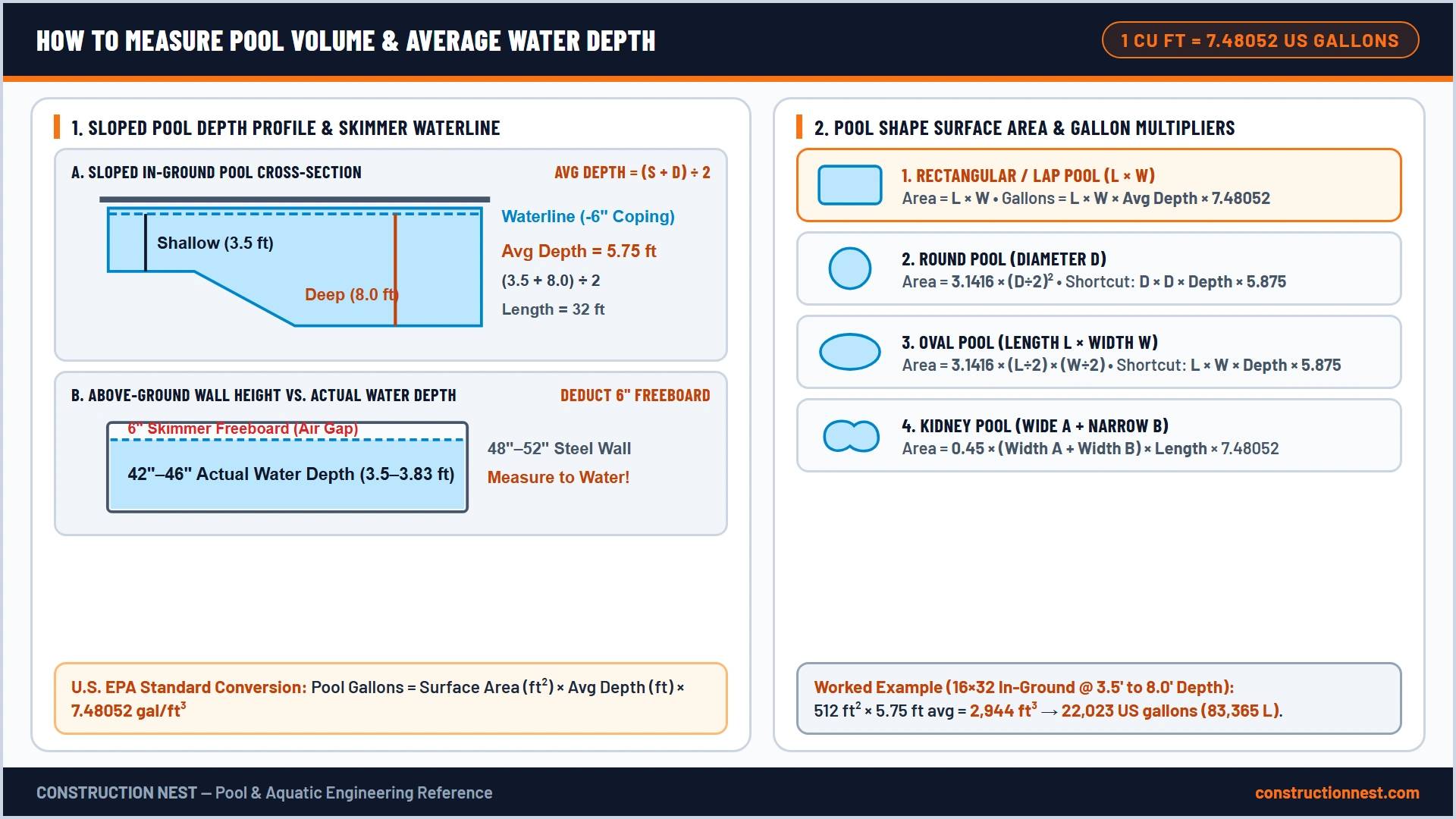
Pool service technicians often use rounded multipliers when doing quick mental math on a job site: 7.5 for rectangular pools, 5.9 (`3.1416 ÷ 4 × 7.48052 = 5.875`) for round or oval pools, and 3.37 (`0.45 × 7.48052 = 3.366`) for kidney-shaped pools. While field shortcuts work for rough estimates, our pool volume calculator uses full floating-point geometry so your chlorine, muriatic acid, cyanuric acid stabilizer, and pool salt doses stay exact to the nearest gallon.
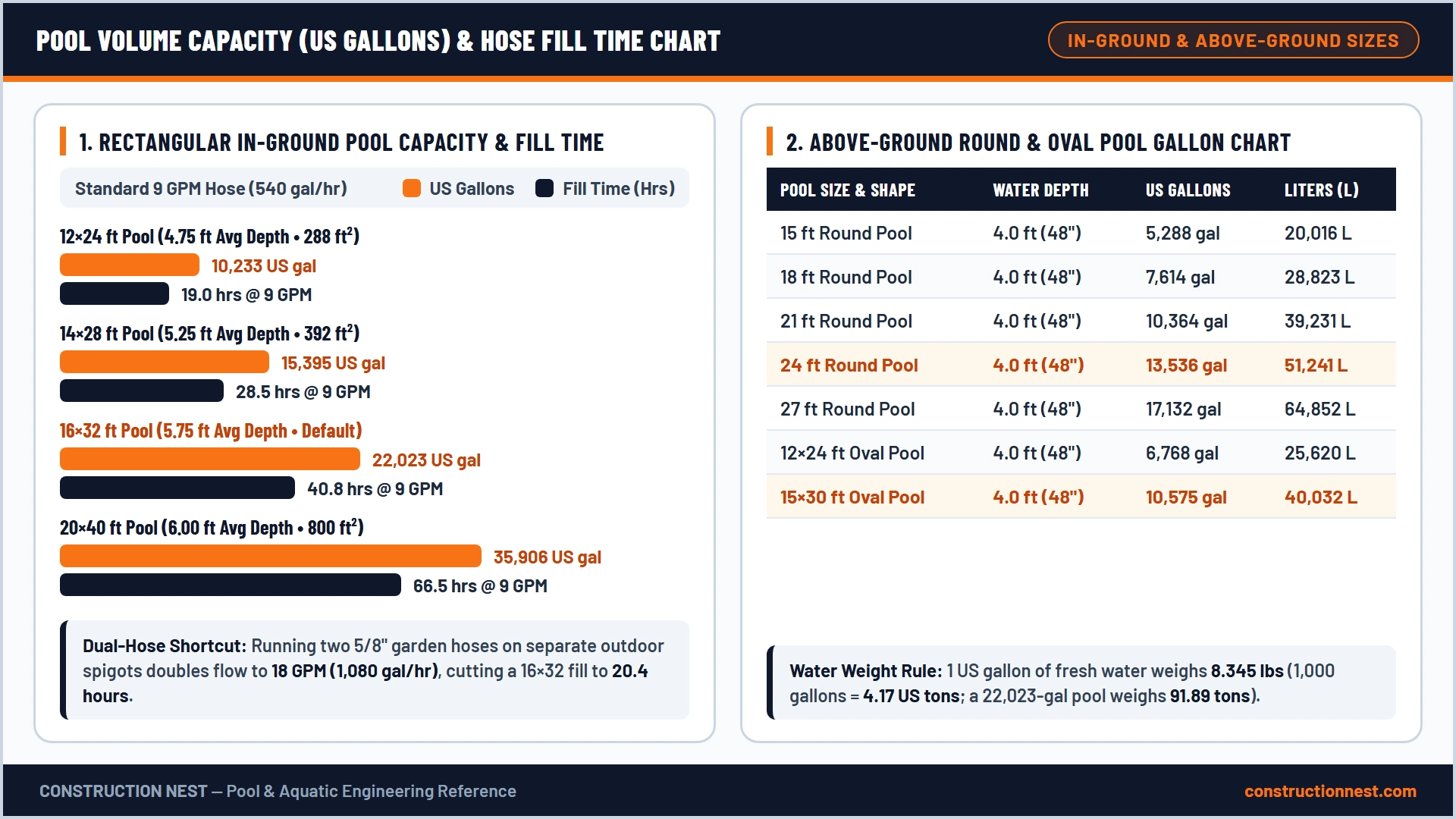
In my field experience auditing residential pool builds and chemical dosing logs, guessing a pool’s capacity by eye is the number-one cause of over-acidified plaster and salt-cell high-ppm shutoffs. A standard 12 ft × 24 ft in-ground pool holds 10,233 US gallons, a 16 ft × 32 ft family pool holds 22,023 US gallons, and a 20 ft × 40 ft lap and diving pool holds 35,906 US gallons.
Use the two engineering lookup tables below to compare cubic feet, US liquid gallons, metric liters, total water weight in US short tons, and 9 GPM garden hose fill hours across standard in-ground and above-ground pool sizes.
| In-Ground Rectangular Size | Surface Area | Shallow / Deep (Avg Depth) | Cubic Feet | US Gallons | Liters (L) | Water Weight | Fill Time (9 GPM) |
|---|---|---|---|---|---|---|---|
| 10 × 20 ft (Plunge / Cocktail) | 200 sq ft | 3.5 ft / 5.5 ft (4.50 ft) | 900.00 ft³ | 6,732 gal | 25,485 L | 28.09 tons | 12.5 hours |
| 12 × 24 ft (Compact Courtyard) | 288 sq ft | 3.5 ft / 6.0 ft (4.75 ft) | 1,368.00 ft³ | 10,233 gal | 38,738 L | 42.70 tons | 19.0 hours |
| 14 × 28 ft (Mid-Size Family) | 392 sq ft | 3.5 ft / 7.0 ft (5.25 ft) | 2,058.00 ft³ | 15,395 gal | 58,276 L | 64.24 tons | 28.5 hours |
| 16 × 32 ft (Standard Family) | 512 sq ft | 3.5 ft / 8.0 ft (5.75 ft) | 2,944.00 ft³ | 22,023 gal | 83,365 L | 91.89 tons | 40.8 hours |
| 18 × 36 ft (Large Family) | 648 sq ft | 3.5 ft / 8.5 ft (6.00 ft) | 3,888.00 ft³ | 29,084 gal | 110,096 L | 121.36 tons | 53.9 hours |
| 20 × 40 ft (Estate / Diving) | 800 sq ft | 3.5 ft / 8.5 ft (6.00 ft) | 4,800.00 ft³ | 35,906 gal | 135,921 L | 149.82 tons | 66.5 hours |
Above-ground pools are sold by their exterior steel or resin wall height—usually 48 inches (4.0 ft), 52 inches (4.33 ft), or 54 inches (4.5 ft). Because the water level must sit 6 inches below the top rail so the surface skimmer weir can trap floating leaves, a 48-inch wall pool holds only 3.5 feet (42 inches) of actual water, while a 52-to-54-inch wall pool holds 4.0 feet (48 inches) of water. The table below compares both actual water depths so you never overdose an above-ground liner with shock.
| Above-Ground Pool Size & Shape | Surface Area | Gallons @ 3.5 ft Water (48″ Wall) | Gallons @ 4.0 ft Water (52″–54″ Wall) | Liters @ 4.0 ft Water | Water Weight @ 4.0 ft | Fill Time @ 9 GPM (4.0 ft) |
|---|---|---|---|---|---|---|
| 12 ft Round | 113.10 sq ft | 2,961 gal | 3,384 gal | 12,810 L | 14.12 tons | 6.3 hours |
| 15 ft Round | 176.71 sq ft | 4,627 gal | 5,288 gal | 20,016 L | 22.06 tons | 9.8 hours |
| 18 ft Round | 254.47 sq ft | 6,662 gal | 7,614 gal | 28,823 L | 31.77 tons | 14.1 hours |
| 21 ft Round | 346.36 sq ft | 9,068 gal | 10,364 gal | 39,231 L | 43.24 tons | 19.2 hours |
| 24 ft Round | 452.39 sq ft | 11,844 gal | 13,536 gal | 51,241 L | 56.48 tons | 25.1 hours |
| 27 ft Round | 572.56 sq ft | 14,990 gal | 17,132 gal | 64,852 L | 71.49 tons | 31.7 hours |
| 30 ft Round | 706.86 sq ft | 18,507 gal | 21,151 gal | 80,064 L | 88.25 tons | 39.2 hours |
| 12 × 24 ft Oval | 226.19 sq ft | 5,922 gal | 6,768 gal | 25,620 L | 28.24 tons | 12.5 hours |
| 15 × 30 ft Oval | 353.43 sq ft | 9,253 gal | 10,575 gal | 40,032 L | 44.13 tons | 19.6 hours |
| 18 × 33 ft Oval | 466.53 sq ft | 12,215 gal | 13,960 gal | 52,843 L | 58.25 tons | 25.9 hours |
Walking through step-by-step arithmetic shows how surface area, average depth, and the 7.48052 gal/ft³ factor verified by the U.S. Environmental Protection Agency (EPA) mix across four real residential pool layouts. Every example below matches the exact numbers produced by our pool volume calculator above.
A 16 by 32 foot rectangular pool with a 3.5-foot shallow end and an 8.0-foot deep end holds 22,023 US gallons (83,365 liters) across 2,944.00 cubic feet of water, weighing 91.89 US short tons and taking 40.8 hours to fill at 9 GPM.
A 20 by 40 foot rectangular pool sloping from 3.5 feet in the shallow end to 8.5 feet in the diving well holds 35,906 US gallons (135,921 liters) and weighs 149.82 US tons.
A 24-foot round above-ground pool filled to a 4.0-foot flat water depth holds 13,536 US gallons (51,241 liters) across 1,809.56 cubic feet and takes 25.1 hours to fill at 9 GPM.
A 30-foot curving kidney pool measuring 16 feet across the wide lobe, 12 feet across the narrow lobe, and 5.0 feet in average depth holds 14,138 US gallons (53,519 liters) across 1,890.00 cubic feet.
In my field experience commissioning newly plastered pools and sizing variable-speed filtration pumps, homeowners routinely underestimate both garden hose fill times and the chemical sensitivity of a 10% to 20% volume mistake. A standard residential spigot mated with a 5/8-inch garden hose delivers 8 to 10 gallons per minute (540 gallons per hour at 9 GPM), filling a 22,023-gallon pool in 40.8 hours at a municipal tap water cost of $110 to $220.
According to residential water flow benchmarks from U.S. EPA WaterSense, outdoor hose bibb flow varies between 5 and 12 GPM depending on street main pressure (`45 to 75 PSI`), pipe diameter (`1/2 inch` vs. `3/4 inch`), and hose length. Before starting a multi-day hose fill, time how many seconds it takes your hose to fill a 5-gallon bucket and use this formula:
Garden Hose Flow Rate (GPM) = 300 ÷ Seconds to Fill a 5-Gallon Bucket
Pool Hose Fill Time (Hours) = Total Pool Volume (US Gallons) ÷ (Flow Rate GPM × 60)
Minimum Pump Turnover Flow (GPM) = Total Pool Volume (US Gallons) ÷ (Turnover Hours × 60)
| Water Fill Approach | Flow Rate (GPM) | Gallons per Hour | 10,233 Gal (12×24) | 13,536 Gal (24′ Round) | 22,023 Gal (16×32) | 35,906 Gal (20×40) |
|---|---|---|---|---|---|---|
| Low-Pressure / 1/2″ Hose | 6 GPM | 360 gal/hr | 28.4 hours | 37.6 hours | 61.2 hours | 99.7 hours |
| Standard 5/8″ Garden Hose | 9 GPM | 540 gal/hr | 19.0 hours | 25.1 hours | 40.8 hours | 66.5 hours |
| High-Flow 3/4″ Contractor Hose | 12 GPM | 720 gal/hr | 14.2 hours | 18.8 hours | 30.6 hours | 49.9 hours |
| Two 5/8″ Hoses (Separate Spigots) | 18 GPM | 1,080 gal/hr | 9.5 hours | 12.5 hours | 20.4 hours | 33.2 hours |
| Bulk Water Delivery Truck | 50 GPM | 3,000 gal/hr | 3.4 hours | 4.5 hours | 7.3 hours | 12.0 hours |
Precise water volume is also the foundation of safe water sanitation. As defined by the U.S. Centers for Disease Control and Prevention (CDC), keeping proper free chlorine (1 to 3 ppm) and pH (7.2 to 7.8) stops recreational water illnesses and protects pool heaters and plaster finishes. Every pool chemical label—from liquid sodium hypochlorite to muriatic acid and pool salt—is dosed per 10,000 US gallons. Guessing your pool size off by 20% creates instant chemical issues:
| Pool Water Treatment Job | Standard Dose per 10,000 Gal | Exact Dose for 22,023 Gal (16×32) | Outcome of +20% Volume Over-Guess | Outcome of -20% Volume Under-Guess |
|---|---|---|---|---|
| Liquid Chlorine (12.5% Bleach) Raise Free Chlorine by +2 ppm |
20.5 fl oz (1.6 cups) | 45.1 fl oz (3.5 cups) | Over-chlorinated (+2.4 ppm); bleaches vinyl liners | Under-sanitized (+1.6 ppm); algae bloom risk |
| Muriatic Acid (31.45% Baumé) Lower pH from 7.8 to 7.4 |
16.0 fl oz (2.0 cups) | 35.2 fl oz (4.4 cups) | Drops pH below 7.1; etches plaster & heat exchangers | Leaves pH above 7.6; cloudy water & scale |
| Pool Grade Salt (NaCl) Fresh Fill to 3,200 ppm Target |
267 lbs (~6.7 bags) | 588 lbs (15 × 40-lb bags) | Adds 118 lbs excess salt; triggers high-salt shutoff | Cell reads low salt (~2,560 ppm); stops chlorine output |
| Cyanuric Acid (Stabilizer) Fresh Fill to 40 ppm Target |
3.34 lbs (53.4 oz) | 7.36 lbs (117.7 oz) | Over-stabilizes water; causes chlorine lock | UV sunlight burns off free chlorine in 2 hours |
When building or renovating your pool surround, pair your water volume takeoff from this pool volume calculator with our other site-prep tools on Construction Nest inside the Pool Calculators and Landscaping Calculators hubs:

Multiply your pool surface area in square feet by its average water depth in feet ((Shallow Depth + Deep Depth) ÷ 2) to get cubic feet, then multiply by 7.48052 to convert cubic feet into US liquid gallons. For example, a 16 ft × 32 ft pool averaging 5.75 ft deep holds 512 × 5.75 × 7.48052 = 22,023 US gallons.
A standard 16 ft × 32 ft in-ground rectangular pool with a 3.5-foot shallow end and an 8.0-foot deep end (5.75-foot average depth) holds 22,023 US gallons (83,365 liters or 2,944 cubic feet). If the deep end is 6.0 feet (4.75-foot average depth), it holds 18,193 US gallons.
A 15-foot round above-ground pool holds 5,288 US gallons (20,016 liters) at a 4.0-foot water depth, or 4,627 US gallons at a 3.5-foot water depth (inside a 48-inch steel wall). A 24-foot round pool holds 13,536 US gallons at 4.0 feet of water or 11,844 US gallons at 3.5 feet of water.
A 20 ft × 40 ft rectangular swimming pool (800 sq ft) with a 3.5-foot shallow end and an 8.5-foot deep end (6.0-foot average depth) holds 35,906 US gallons (135,921 liters or 4,800 cubic feet), weighing 149.82 US short tons.
At a standard single garden hose flow rate of 9 GPM (540 gallons per hour), filling a 13,536-gallon 24-foot round pool takes 25.1 hours, and filling a 22,023-gallon 16×32 in-ground pool takes 40.8 hours. Running two garden hoses on separate spigots (18 GPM) cuts fill time in half to 20.4 hours.