
Estimate composite and wood deck installation cost, framing elevation, railing, stairs, and 16-foot board takeoff.
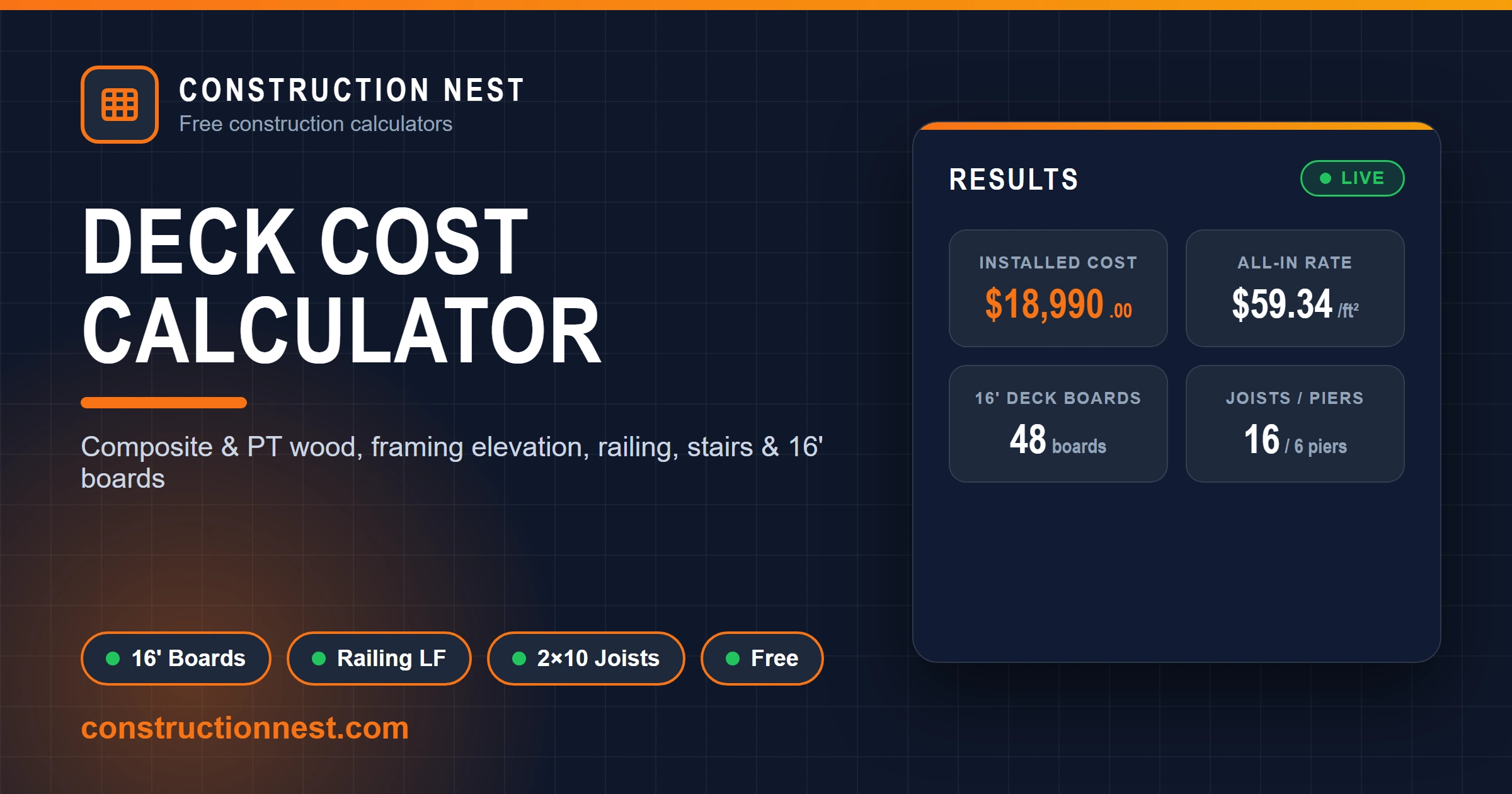
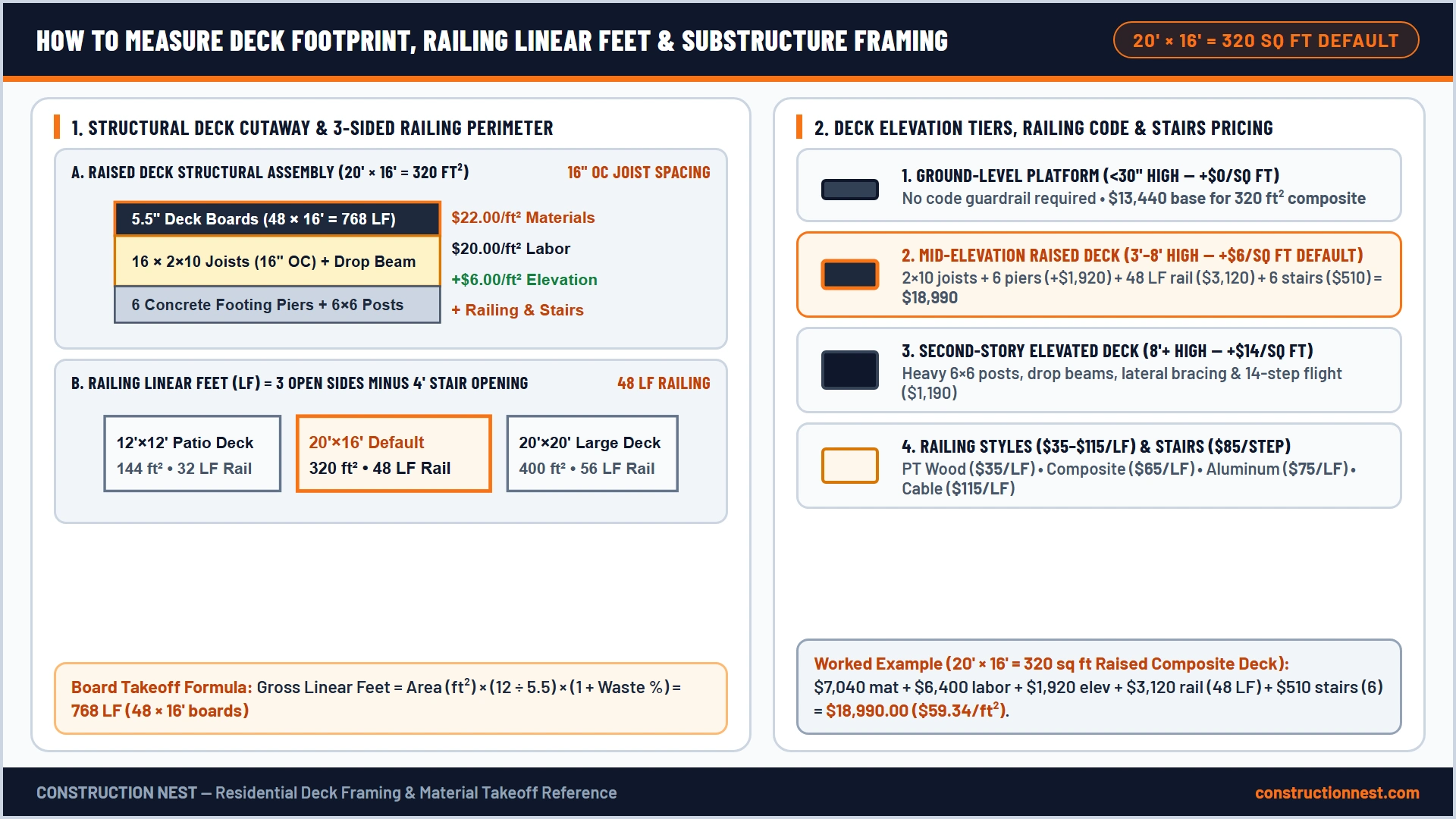
Use this free Deck Cost Calculator to estimate your total installed price for a composite, pressure-treated wood, Western red cedar, PVC, or Ipe hardwood deck, complete with substructure framing, elevation height, railing linear feet, stairs, and an exact 16-foot decking board takeoff. Try the default: a 20 ft × 16 ft (320 sq ft) mid-elevation composite deck with 48 linear feet of composite railing ($3,120.00) and 6 stair steps ($510.00) costs $18,990.00 installed ($59.34/sq ft all-in) and requires 48 sixteen-foot deck boards (768 LF w/ +10% waste), 16 joists (2×10 at 16″ OC), and 6 concrete piers.
It takes less than 30 seconds to calculate your turnkey deck installation cost, perimeter railing and stair pricing, and 16-foot decking board takeoff.
Select Length × Width to enter exact ledger length and projection width (default 20 ft × 16 ft = 320 sq ft), Deck Size Preset to test common footprints from 12’×12′ to 20’×30′, or Total Area to enter square feet or square yards directly.
Choose Composite Decking ($22/ft² mat + $20/ft² labor = $42/ft² base), Pressure-Treated Pine ($28/ft² base), Western Red Cedar / Redwood ($36/ft² base), PVC Capped Polymer ($48/ft² base), or Ipe Hardwood ($60/ft² base).
Pick Ground-Level Platform (<30″ high — +$0/ft²), Mid-Elevation Raised Deck (3 to 8 ft high — +$6/ft²) for 2×10 joists and concrete piers, or Second-Story Elevated Deck (8 ft+ high — +$14/ft²).
Select your guardrail style (from $35/LF PT wood to $65/LF composite or $115/LF cable), enter open perimeter length (default 48 LF), pick stair steps at $85/step, and set board waste (+10% parallel or +15% diagonal).
Click Calculate Deck Cost to view your itemized cost breakdown, 16-foot board count, 2×10 joists, and concrete piers. Copy the summary table or download the official A4 PDF report.
Pricing a new backyard deck by looking only at surface board tags in a lumber aisle leads to big budget surprises. Walking planks make up just 35% to 42% of a finished outdoor platform once treated joists, concrete piers, guardrails, stairs, and carpenter wages are added. Our Deck Cost Calculator gives you an itemized estimate covering deck board materials, substructure material, labor cost, elevation framing, perimeter railing, stairs, and an exact 16-foot board takeoff.
Instead of showing a wide $5,000 to $50,000 guess, this Deck Cost Calculator models how a professional contractor builds an outdoor living platform from the frost line up. Across the United States in 2026, residential projects average $28.00 to $60.00 per square foot for the base platform, or $44.59 to $77.34 per square foot all-in once mid-elevation framing, code guardrails, and a 6-step flight of stairs are included.
Every result inside our Deck Cost Calculator comes from five transparent carpenter equations. First, we find your net walking area in square feet:
Net Deck Area (sq ft) = Deck Length (ft) × Deck Width (ft)
Standard 5/4×6 and 2×6 boards measure 5.5 inches wide (0.4583 feet). That means each square foot of surface area requires 2.1818 linear feet of planking before offcuts. Adding your waste percentage converts net area into gross board linear feet and standard 16-foot boards:
Gross Decking Linear Feet = Net Deck Area (sq ft) × (12 ÷ 5.5) × (1 + Waste % ÷ 100)
16-Foot Decking Boards = Ceiling(Gross Decking Linear Feet ÷ 16)
Next, our Deck Cost Calculator adds your five cost buckets—surface and substructure materials, carpentry labor, elevation framing, perimeter railing, and stair steps—to find your total installed price and all-in cost per square foot:
Total Deck Cost = (Area × Material $/ft²) + (Area × Labor $/ft²) + (Area × Elevation $/ft²) + (Railing LF × Railing $/LF) + (Stair Steps × $85)
All-In Cost per Square Foot = Total Deck Cost ÷ Net Deck Area (sq ft)
In my professional experience, I have found that homeowners often compare a single 16-foot treated pine board against a composite board at the store and assume a composite project costs three times as much. That store-shelf math misses a huge piece of the puzzle. Whether you walk on budget pine or high-end PVC, both decks sit on the exact same pressure-treated 2×10 substructure, galvanized joist hangers, ledger flashing, and poured concrete footings, which account for 55% to 65% of the total build.
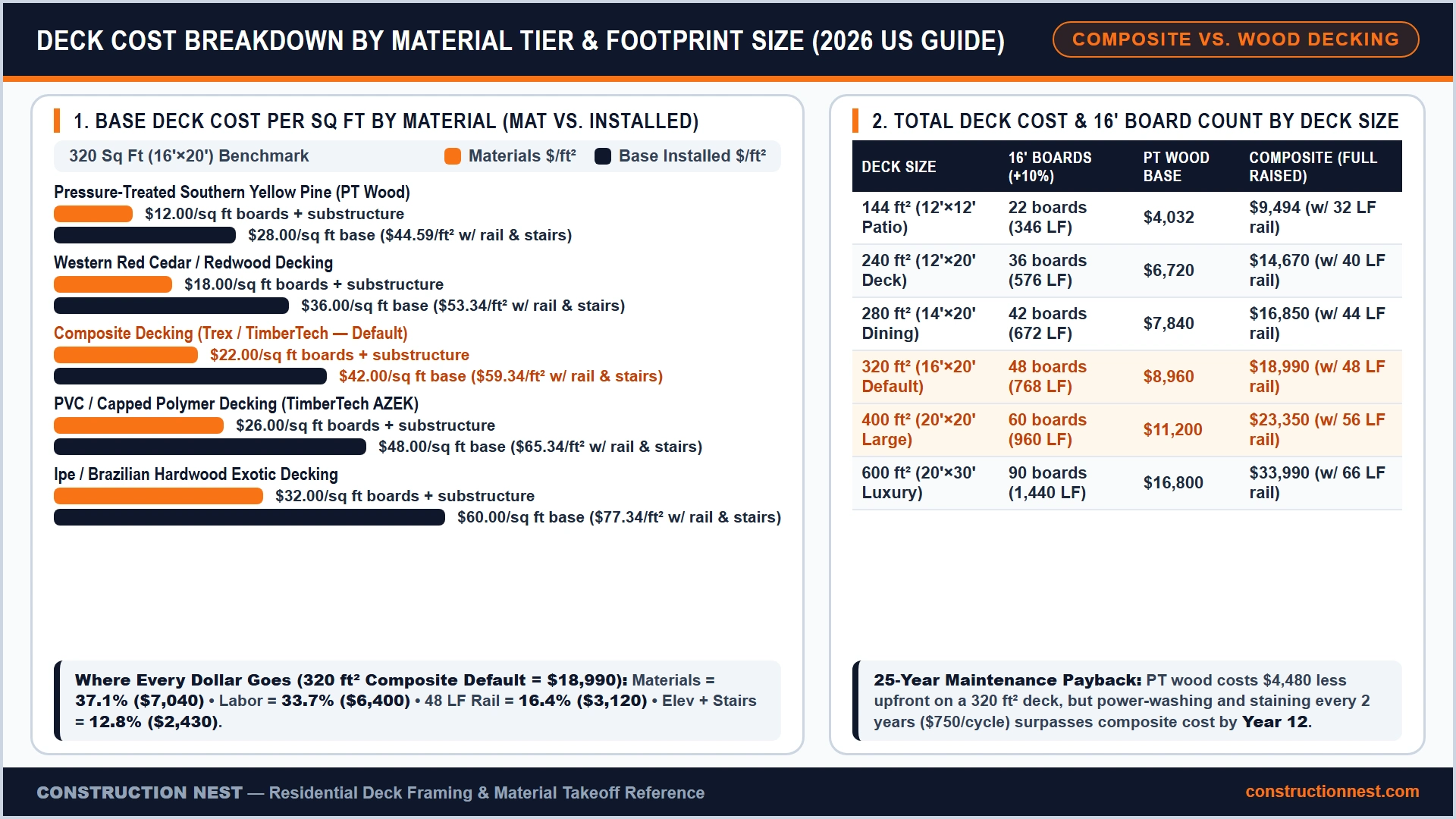
When you use our Deck Cost Calculator as a Composite vs Wood Deck Cost Estimator, you can see that upgrading a 320-square-foot raised structure from pressure-treated pine to grooved composite raises the total turnkey price from $13,070 to $18,990. That is a 45.3% increase on the total contract—not triple the price—because excavation, pier footings, framing lumber, and carpenter framing hours stay nearly identical.
Let us walk through the exact numbers for the default benchmark inside our Deck Cost Calculator: a 20 ft long by 16 ft wide (320 sq ft / 35.6 sq yd) mid-elevation raised composite deck built 4 feet off the ground with 48 linear feet of composite guardrail, 6 stair steps, and a +10% board waste allowance:
If you are milling or ordering rough-sawn cedar, redwood, or exotic hardwood lumber by volume rather than square footage, run your plank dimensions through our Board Foot Calculator and check your individual plank lengths with our Linear Feet Calculator.
| Decking Board Material Tier | Materials + Substructure ($/ft²) | Carpentry Labor ($/ft²) | Base Platform Rate ($/ft²) | 320 Sq Ft Base Cost | 320 Sq Ft Full Raised Cost* |
|---|---|---|---|---|---|
| Pressure-Treated Pine (PT Wood) | $12.00 / sq ft | $16.00 / sq ft | $28.00 / sq ft | $8,960 | $13,070 ($40.84/ft² w/ PT rail) |
| Western Red Cedar / Redwood | $18.00 / sq ft | $18.00 / sq ft | $36.00 / sq ft | $11,520 | $15,630 ($48.84/ft² w/ wood rail) |
| Composite Decking (Default) | $22.00 / sq ft | $20.00 / sq ft | $42.00 / sq ft | $13,440 | $18,990 ($59.34/ft² w/ comp rail) |
| PVC / Capped Polymer Decking | $26.00 / sq ft | $22.00 / sq ft | $48.00 / sq ft | $15,360 | $21,390 ($66.84/ft² w/ alum rail) |
| Ipe / Brazilian Hardwood | $32.00 / sq ft | $28.00 / sq ft | $60.00 / sq ft | $19,200 | $27,150 ($84.84/ft² w/ cable rail) |
*Note: Full Raised Cost includes a 320 sq ft mid-elevation frame (+$6.00/sq ft = $1,920), 48 linear feet of matching perimeter guardrail, and 6 stair steps ($510).
When using a Cost to Build a Deck Calculator, total square footage and height off the ground drive your structural lumber bill. A compact 12 ft × 12 ft (144 sq ft) ground-level patio platform needs zero guardrails and sits on simple concrete deck blocks or shallow piers, costing just $4,032 in pressure-treated pine or $6,048 in composite.
Once your walking surface rises more than 30 inches above grade, residential building codes require a continuous 36-inch-high guardrail capable of resisting a 200-pound concentrated load, plus stair stringers and frost-depth footings. Compare seven standard US deck sizes below using the exact math from our Deck Cost Calculator:
| Deck Size & Footprint | 16′ Boards (+10% Waste) | 2×10 Joists / Piers | PT Wood Base (Ground) | Composite Base (Ground) | Full Raised Composite* |
|---|---|---|---|---|---|
| 144 sq ft (12’×12′ Patio Deck) | 22 boards (346 LF) | 10 joists / 4 piers | $4,032 | $6,048 | $9,494 (32 LF rail) |
| 240 sq ft (12’×20′ Grill Deck) | 36 boards (576 LF) | 16 joists / 5 piers | $6,720 | $10,080 | $14,630 (40 LF rail) |
| 280 sq ft (14’×20′ Dining Deck) | 42 boards (672 LF) | 16 joists / 6 piers | $7,840 | $11,760 | $16,810 (44 LF rail) |
| 288 sq ft (12’×24′ Porch Deck) | 44 boards (691 LF) | 19 joists / 6 piers | $8,064 | $12,096 | $17,194 (44 LF rail) |
| 320 sq ft (16’×20′ Family Default) | 48 boards (768 LF) | 16 joists / 6 piers | $8,960 | $13,440 | $18,990 (48 LF rail) |
| 400 sq ft (20’×20′ Entertaining) | 60 boards (960 LF) | 16 joists / 8 piers | $11,200 | $16,800 | $23,350 (56 LF rail) |
| 600 sq ft (20’×30′ Multi-Zone) | 90 boards (1,440 LF) | 24 joists / 11 piers | $16,800 | $25,200 | $33,600 (66 LF rail) |
*Note: Full Raised Composite column includes base composite deck ($42/sq ft), mid-elevation framing (+$6/sq ft), 3-sided composite railing ($65/LF), and 6 stair steps ($510).
I have handled cases across dozens of residential builds where a homeowner budgeted carefully for surface planks but forgot that perimeter guardrails, stairs, and structural wood protection make up nearly 30% of the final invoice. On our 320-square-foot default build inside the Deck Cost Calculator, adding 48 linear feet of composite railing ($3,120), 6 stair steps ($510), and mid-elevation post-and-beam framing ($1,920) adds $5,550.00 to the base platform.
According to engineering research published in the USDA Forest Service — Forest Products Laboratory Wood Handbook, outdoor wood exposed to rain and ultraviolet sunlight shrinks and swells across the grain while remaining vulnerable to fungal decay at ledger and joist joints. To prevent premature rot in the substructure, the U.S. Environmental Protection Agency (EPA) outlines modern copper-based wood preservatives—such as Micronized Copper Azole (MCA) and Alkaline Copper Quaternary (ACQ)—that protect ground-contact posts and joists for 25 to 40 years when paired with hot-dipped galvanized or stainless-steel fasteners.
Before signing a contract or pulling municipal building permits (which typically cost $150 to $500), check how each structural upgrade changes your estimate in our Deck Cost Calculator:
| Deck Component or Upgrade | 2026 Installed Unit Rate | Cost on 320 Sq Ft Deck (48 LF) | Building Code & Job-Site Rule |
|---|---|---|---|
| PT Wood Baluster Railing | $35.00 / linear ft | $1,680.00 | Max 4-inch clear gap between vertical balusters |
| Composite Railing w/ Balusters | $65.00 / linear ft | $3,120.00 | Matches composite fascia; zero painting or staining |
| Black Aluminum Baluster Railing | $75.00 / linear ft | $3,600.00 | Slim profile keeps backyard sightlines open |
| Stainless Steel Cable Railing | $115.00 / linear ft | $5,520.00 | Tension cables so a 4-inch sphere cannot pass through |
| Exterior Deck Stairs (per Step) | $85.00 / step | $510.00 (6 steps) | Max 7.75-inch riser height and min 10-inch tread depth |
| Butyl Joist Flashing Tape | $0.65 / sq ft of deck | $208.00 | Seals screw holes on top of 2×10 joists to stop rot |

A 16 ft × 20 ft (320 sq ft) deck costs $18,990.00 turnkey ($59.34 per sq ft) for a mid-elevation raised composite deck, which includes $7,040.00 for 48 sixteen-foot composite boards and treated substructure materials, $6,400.00 for carpentry labor, $1,920.00 for mid-elevation 2×10 framing and 6 concrete piers, $3,120.00 for 48 linear feet of composite railing, and $510.00 for 6 stair steps. For a low ground-level 16×20 platform without railings or stairs, base costs are $8,960 ($28/sq ft) in pressure-treated pine and $13,440 ($42/sq ft) in composite.
A 20 ft × 20 ft (400 sq ft) deck costs $11,200 to $23,350 installed depending on material and elevation. A ground-level 400 sq ft deck costs $11,200 ($28/sq ft) in pressure-treated wood or $16,800 ($42/sq ft) in composite decking, while a raised 20×20 composite deck with mid-elevation framing ($2,400), 56 linear feet of composite railing ($3,640), and 6 stair steps ($510) totals $23,350 ($58.38/sq ft) and requires 60 sixteen-foot decking boards (960 LF).
A 14 ft × 20 ft (280 sq ft) deck costs $7,840 for a ground-level pressure-treated pine build, $11,760 for a ground-level composite build, and $16,810 installed ($60.04/sq ft) for a raised mid-elevation composite deck complete with 44 linear feet of composite guardrail ($2,860) and 6 stair steps ($510). It requires 42 sixteen-foot decking boards (672 LF) with +10% waste.
Yes—while composite decking ($42/sq ft base) costs $4,480 more upfront than pressure-treated pine ($28/sq ft base) on a 320 sq ft deck, a wood deck requires power-washing, sanding, and staining every 2 years at $650 to $900 per maintenance cycle. By Year 11 to Year 12, cumulative wood upkeep surpasses the initial composite upgrade cost, and composite boards last 25 to 30+ years without splintering or warping.
The 3-4-5 rule is a right-triangle geometry check (3² + 4² = 5²) used by carpenters to make sure a deck frame meets the house ledger at an exact 90-degree square corner. Measure 3 feet (or 12 feet) along the house ledger board, measure 4 feet (or 16 feet) out along the side rim joist, and adjust the rim joist until the diagonal tape measurement between those two marks equals exactly 5 feet (or 20 feet).