Calculate artificial turf installation cost, 15-ft roll length, crushed stone sub-base tons, and 50-lb infill bags.
Use this free Artificial Turf Cost Calculator to estimate your total project price, 15-foot synthetic grass roll length, crushed stone sub-base tonnage, 50-lb infill bags, and contractor labor. Try the default: a 30 ft × 20 ft (600 sq ft) lawn with standard 60–70 oz landscape turf ($2.85/sq ft) and +10% waste (660 sq ft = $1,881.00), plus turnkey labor ($3,900.00), 7.88 tons of 3-inch road base ($433.13), and 18 bags of infill ($252.00), costs $6,466.13 installed ($10.78/sq ft all-in).
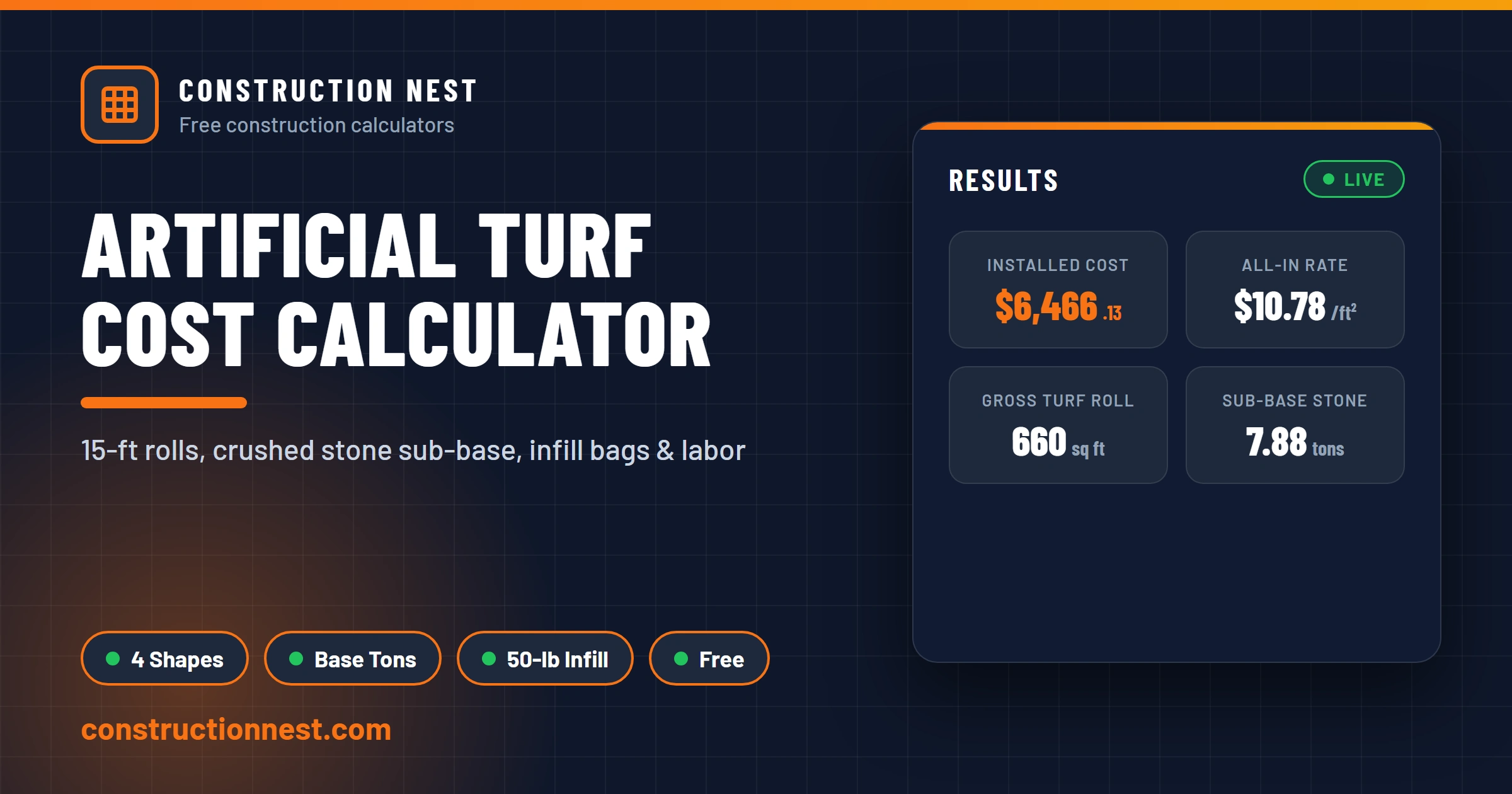
It takes less than 30 seconds to calculate your synthetic grass roll footage, crushed stone sub-base tonnage, 50-lb infill bags, and turnkey installation cost.
Select Rectangle Lawn for standard yards, Circle / Green for round putting greens, Total Area if you already measured your square footage, or Triangle for angled corner lots.
Enter your lawn dimensions in feet, inches, yards, or meters and select your turf roll width (default 15-ft standard roll or 12-ft narrow roll) to calculate linear roll footage and seam tape length.
Select your synthetic grass tier (default Standard Landscape Turf at $2.85/sq ft, Economy at $1.95/sq ft, Pet Turf at $3.75/sq ft, or Putting Green Nylon at $4.50/sq ft) and choose Standard Pro Install ($6.50/sq ft), Complex Install ($8.50/sq ft), or DIY Material Only ($0/sq ft).
Choose your compacted road base depth (3 inches standard, 4 inches for pet/high-drainage lawns, or 0 inches over concrete) and infill rate (1.5 to 2.5 lbs/sq ft).
Click Calculate Turf Cost to view your itemized breakdown, sub-base tons, 50-lb infill bag count, and landscape spike takeoff. Copy the summary table or download the official A4 PDF report.
Replacing a thirsty grass yard with synthetic turf takes more than just buying a roll of fake grass. You have to dig out the old sod. You have to haul in tons of crushed stone base. Then you have to cut 15-foot-wide turf rolls, glue the seams, hammer in 6-inch spikes, and brush in bags of sand infill. Our Contrived Turf Cost Calculator computes your exact project price, synthetic grass roll footage, crushed stone sub-base tonnage, and 50-lb infill bag count in seconds.
Most online turf estimators only multiply your square footage by a rough dollar range. That approach hides where your money actually goes. In a real backyard installation, the synthetic grass roll itself is less than a third of the total bill. Site excavation, Class II road base compaction, and skilled seaming labor make up over 60% of the turnkey price. Whether you are pricing a full contractor install or ordering DIY materials for a weekend backyard putting green, this tool breaks down every single line item.
Every calculation inside our widget uses standard hardscape and synthetic turf engineering equations. First, we convert your net careful lawn area into gross turf roll square footage and linear roll feet:
Gross Turf Area (sq ft) = Net Lawn Area (sq ft) × (1 + Waste % ÷ 100)
Linear Roll Feet (ft) = Gross Turf Area (sq ft) ÷ Roll Width (15 ft or 12 ft)
Next, we calculate the compacted volume and weight of your crushed stone sub-base (Class II road base or decomposed granite at 105 lbs per cubic foot) along with your 50-lb infill bags:
Sub-Base Volume (yd³) = [Net Lawn Area (sq ft) × (Base Depth in Inches ÷ 12)] ÷ 27
Sub-Base Weight (US Short Tons) = [Net Lawn Area (sq ft) × (Base Depth in Inches ÷ 12) × 105] ÷ 2,000
50-lb Infill Bags = Ceiling [ (Net Lawn Area × Infill Rate in lbs/sq ft) ÷ 50 ]
Finally, we sum the four core project cost buckets to give you your total installed price and all-in rate per square foot:
Total Installed Cost = (Gross Area × Turf $/ft²) + (Net Area × Labor $/ft²) + (Base Tons × $/Ton) + (Infill Bags × $/Bag)
Homeowners nearly always get surprised when a contractor bills them for 750 square feet of turf on a 600-square-foot yard. Why does that happen? It comes down to how synthetic grass leaves the factory. Unlike natural sod—which arrives on pallets of tiny 16-inch by 24-inch rectangles that you can puzzle-piece into any corner—artificial turf is crested onto massive carpet looms that are purely 15 feet wide (by up to 100 feet long).
Think about what happens when your backyard lawn is 30 feet long by 20 feet wide (600 net sq ft). One 15-foot-wide strip covers the first 15 feet of width. That leaves a 5-foot-wide strip along the back fence. Even when you order a custom cut from a distributor, you have to buy full or half roll widths, and every single strip must be laid with the grass blade grain pointing in the exact same direction. If you rotate a leftover scrap 90 degrees to patch that 5-foot strip, the sunlight will reflect off the polyethylene blades at a different angle. Your yard will look like a two-tone checkerboard forever.
Let us walk through the exact math for our calculator’s default benchmark: a 30 ft × 20 ft rectangular lawn (600 net sq ft) using standard 60–70 oz landscape turf ($2.85/sq ft), turnkey pro installation labor ($6.50/sq ft), a 3-inch compacted crushed stone base (at $55/ton), 1.5 lbs/sq ft of silica sand infill (at $14 per 50-lb bag), and a +10% waste allowance:
If you’re still comparing synthetic grass against live turfgrass rolls, run the same 600-square-foot dimensions through our Sod Calculator to compare upfront pallet costs against five-year watering bills.
Across the Joined States, turnkey professional contrived turf installation averages between $9.50 and $15.00 per square foot, while DIY material-only packages run $3.30 to $6.40 per square foot (including the turf roll, crushed stone base, and infill bags). Small dog runs under 200 square feet often cost $13 to $18 per square foot professionally installed because crews still have to circulate a dump trailer, sod cutter, and vibratory plate compactor for a full day.
| Net Lawn Size (Sq Ft) | Gross Turf (+10% Waste) | 15-Ft Roll Length | 3″ Sub-Base Stone | 50-lb Infill Bags | DIY Material Total | Turnkey Pro Total |
|---|---|---|---|---|---|---|
| 200 sq ft (10’×20′ Dog Run) | 220 sq ft | 14.7 linear ft | 2.63 tons (1.85 yd³) | 6 bags (300 lbs) | $855 | $2,155 |
| 400 sq ft (20’×20′ Courtyard) | 440 sq ft | 29.3 linear ft | 5.25 tons (3.70 yd³) | 12 bags (600 lbs) | $1,711 | $4,311 |
| 600 sq ft (30’×20′ Default) | 660 sq ft | 44.0 linear ft | 7.88 tons (5.56 yd³) | 18 bags (900 lbs) | $2,566 | $6,466 |
| 800 sq ft (40’×20′ Side/Back) | 880 sq ft | 58.7 linear ft | 10.50 tons (7.41 yd³) | 24 bags (1,200 lbs) | $3,422 | $8,622 |
| 1,000 sq ft (40’×25′ Backyard) | 1,100 sq ft | 73.3 linear ft | 13.13 tons (9.26 yd³) | 30 bags (1,500 lbs) | $4,277 | $10,777 |
| 1,500 sq ft (50’×30′ Family Yard) | 1,650 sq ft | 110.0 linear ft | 19.69 tons (13.89 yd³) | 45 bags (2,250 lbs) | $6,415 | $16,165 |
| 2,000 sq ft (50’×40′ Estate Lawn) | 2,200 sq ft | 146.7 linear ft | 26.25 tons (18.52 yd³) | 60 bags (3,000 lbs) | $8,554 | $21,554 |
When you compare turf samples, don’t just feel how soft the blades are. Look at the spec sheet on the back. Two numbers matter most: face weight (how many ounces of yarn are sewed into every square yard, not counting the backing) and fiber chemistry (polyethylene, polypropylene, or nylon).
| Turf Grade & Fiber Type | Face Weight & Pile Height | Roll Material ($/ft²) | DIY All-In ($/ft²) | Turnkey Installed ($/ft²) | Best Use Case & Lifespan |
|---|---|---|---|---|---|
| Economy / Patio Rug Turf (Polypropylene) | 40–50 oz/yd² • 1.25″ pile | $1.95 / sq ft | $3.29 / sq ft | $9.79 / sq ft | Balconies, event mats, low-traffic strips (8–12 yrs) |
| Standard Landscape Turf (Polyethylene + Thatch) | 60–70 oz/yd² • 1.75″ pile | $2.85 / sq ft | $4.28 / sq ft | $10.78 / sq ft | Front & backyard residential lawns (15–20 yrs) |
| Heavy-Duty Pet Turf (Antimicrobial PE) | 65–80 oz/yd² • 1.50″ pile | $3.75 / sq ft | $5.41 / sq ft | $11.91 / sq ft | Dog runs, kennels, high-drainage yards (15–20 yrs) |
| Pro Putting Green Turf (Texturized Nylon) | 50–60 oz/yd² • 0.50″ pile | $4.50 / sq ft | $6.37 / sq ft | $14.87 / sq ft | Backyard golf greens & bocce courts (15–25 yrs) |
If a contrived lawn develops wrinkles, low puddles, or a sour dog-urine smell after two summers, the turf roll is nearly never to blame. The failure happens three inches underground in the sub-base. Never lay synthetic grass over bare dirt, sand, or pea gravel. Round stone shifts underfoot like marbles, leaving craters everywhere you walk. Instead, you need angular, crushed aggregate with stone dust fines—known as Class II Permable Road Base, 3/8-inch minus crushed limestone, or Crushed Miscellaneous Base (CMB)—topped with a 1/2-inch finish screed of Decomposed Granite (DG).
According to aggregate density standards published by the U.S. Environmental Protection Agency (EPA) Material Volume-to-Weight Conversion Factors, compacted crushed stone and sand-gravel sub-bases weigh around 105 lbs per cubic foot (2,835 lbs or 1.42 US short tons per cubic yard). When wetted with a hose and compacted in two lifts with a vibratory plate compactor to 90%–95% Proctor density, this base locks together like porous concrete while still draining 30+ inches of rainwater per hour.
| Sub-Base Depth | Soil & Traffic Application | Volume per 600 Sq Ft | Weight per 600 Sq Ft (@ 105 lb/ft³) | Stone Cost (@ $55/Ton) |
|---|---|---|---|---|
| 0 Inches | Existent concrete patio, balcony, or wood deck (use drainage pad) | 0.00 yd³ (0 ft³) | 0.00 short tons (0 lbs) | $0.00 |
| 2 Inches | Light foot traffic in dry, sandy, well-draining native soil | 3.70 yd³ (100 ft³) | 5.25 short tons (10,500 lbs) | $288.75 |
| 3 Inches (Standard) | Standard residential backyard lawns, kids play areas & patios | 5.56 yd³ (150 ft³) | 7.88 short tons (15,750 lbs) | $433.13 |
| 4 Inches (Heavy / Pet) | Talkative clay soil, large dog runs, golf greens & freeze-thaw zones | 7.41 yd³ (200 ft³) | 10.50 short tons (21,000 lbs) | $577.50 |
If you’re designing decorative dry creek borders or gravel stepping-stone beds around your turf perimeter, you can calculate those border aggregates singly using our Pea Gravel Calculator and River Rock Calculator, or check your excavation dump-trailer loads with our Cubic Yard Calculator.
Why do you pour hundreds of pounds of sand on top of brand-new hokey grass? Infill does three vital jobs. First, it acts as dead-weight ballast (adding 1.5 to 2.5 pounds per square foot) so your turf never ripples or expands when summer sun heats the yard. Second, it packs around the base of the polyethylene fibers to hold every blade standing upright. Third, it cushions the backing fabric from UV sunlight and foot traffic.
Never dump black crumb rubber (recycled tires) into a residential backyard. Crumb rubber gets scorching hot in July, smells like a tire shop, and tracks black dust onto your patio furniture. Select one of these three residential infill choices instead:
| Infill Material Type | Application Rate (lbs/sq ft) | 50-lb Bags per 600 Sq Ft | Cost per 50-lb Bag | Infill Cost (600 Sq Ft) | Best Application |
|---|---|---|---|---|---|
| Sub-Rounded Silica Sand (#20/#30 Mesh) | 1.5 lbs / sq ft | 18 bags (900 lbs) | $10 – $15 ($14 avg) | $252.00 | Standard front & back lawns without heavy dog use |
| Natural Zeolite + Acrylic Coated Sand | 2.0 lbs / sq ft | 24 bags (1,200 lbs) | $22 – $30 ($25 avg) | $600.00 | Dog runs & pet yards (traps ammonia before it smells) |
| Fine Rounded Quartz Putting Green Sand | 2.5 lbs / sq ft | 30 bags (1,500 lbs) | $18 – $24 ($20 avg) | $600.00 | Short-pile nylon golf greens (controls ball roll speed) |
| Non-Infill High-Thatch Turf (Perimeter Spikes Only) | 0.0 lbs / sq ft | 0 bags (0 lbs) | $0 / bag | $0.00 | Balconies, pool decks, and indoor gym/play mats |
While a $6,466 turnkey price tag for a 600-square-foot yard feels steep on day one, synthetic turf is one of the few landscaping upgrades that pays you back every single month. According to outdoor water use data from the U.S. EPA WaterSense Program, the average American household uses more than 30% of its total water outdoors—up to 70% in arid Southwest states—with traditional grass lawns consuming around 55 gallons of irrigation water per square foot each year. On a 600-square-foot lawn, switching to synthetic turf saves around 33,000 gallons of water annually ($350 to $650/year on tiered municipal water bills), plus another $900 to $1,400 per year in mowing, fertilizer, aeration, and sprinkler repairs. Most homeowners reach full payback in 4 to 6 years, a key reason why outdoor hardscaping and low-water landscaping rank among top home remodeling groups tracked by the Harvard University Joint Center for Housing Studies (JCHS).
Before you order your rolls or sign an installer contract, watch out for these five frequent mistakes that ruin synthetic lawns:

Installing 600 square feet of standard 60–70 oz landscape turf costs $6,466.13 turnkey ($10.78 per sq ft all-in), which includes 660 sq ft of turf roll with 10% waste ($1,881.00), professional excavation and seaming labor ($3,900.00), 7.88 tons of 3-inch crushed stone base ($433.13), and 18 bags of 50-lb silica sand infill ($252.00). For a DIY installation, the materials alone cost $2,566.13 ($4.28/sq ft).
For a 1,000-square-foot backyard lawn, turnkey professional installation averages $10,777 (or between $9,790 and $14,870 depending on turf grade and site access). A 1,000 sq ft lawn requires 1,100 gross sq ft of turf (73.3 linear feet of a 15-ft roll), 13.13 short tons (9.26 cubic yards) of 3-inch road base, and 30 bags of 50-lb infill.
At a standard 3-inch compacted depth (using Class II road base or decomposed granite at 105 lbs/ft³), you need 1.3125 US short tons per 100 square feet—or 7.88 tons (5.56 cubic yards) for a 600 sq ft lawn. For a 4-inch pet or heavy-drainage sub-base, order 1.75 tons per 100 square feet (10.50 tons per 600 sq ft).
Multiply your net lawn square footage by your infill rate (1.5 lbs/sq ft for standard landscape turf, 2.0 lbs/sq ft for pet deodorizer infill, or 2.5 lbs/sq ft for putting greens) and divide by 50 lbs. A 600 sq ft lawn at 1.5 lbs/sq ft requires 900 lbs = 18 bags of 50-lb infill.
Yes—according to U.S. EPA WaterSense benchmarks, traditional grass lawns consume roughly 55 gallons of irrigation water per square foot per year (33,000 gallons annually on a 600 sq ft lawn). Eliminating irrigation, mowing, fertilizer, and sprinkler repairs saves $1,100 to $1,800 per year, paying back a turnkey synthetic lawn in 4 to 6 years.