
Concrete volume, bags, gravel and cost for any slab
Planning a patio, shed base or driveway? A 20 × 10 ft slab at 4 inches thick needs about 2.72 cubic yards of concrete with 10% waste. This free concrete slab cost calculator turns your size into yards, bags, gravel and a total cost in seconds.
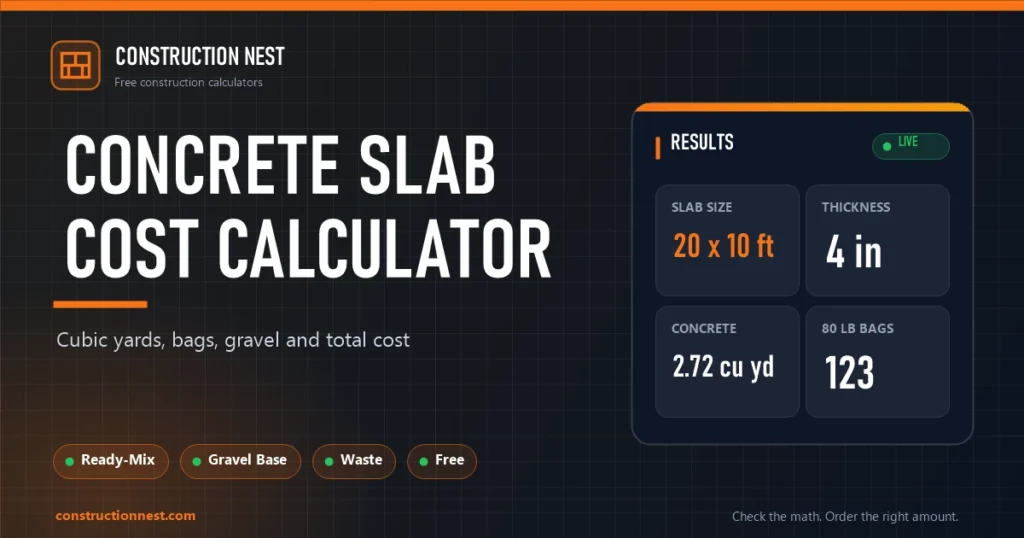
You only need your slab size and thickness. It takes about one minute.
Choose Rectangular Slab for patios and driveways. Use Circular Patio for round pads. Pick Total Surface Area if you already know the sq ft, or Known Volume if you only want to order.
Type the size of your slab. You can use feet, yards or meters. The default is 20 ft × 10 ft.
Enter how thick the concrete will be. A common patio is 4 inches. Make sure the unit says inches, not feet.
Keep 10% waste unless your ground is very flat. Then pick the gravel base depth, such as 4 inches, and choose wire mesh if your plan needs it.
Type your local price for concrete per cubic yard, gravel per ton and labor per sq ft. The starter prices are only examples.
Click Calculate Concrete Slab. You will see ready-mix volume, 80 lb bags, gravel and total cost. Use Copy Summary, PDF or Share to save your plan.
A concrete slab is just a flat box of concrete. So the concrete slab cost calculator first finds the volume of that box. Then it adds waste, turns the volume into cubic yards and bags, and prices the job.
Here is the main math. The thickness must be in feet, so 4 inches = 0.333 ft.
Volume (cu ft) = Length × Width × Thickness
Cubic Yards = Volume ÷ 27
Order Volume = Cubic Yards × (1 + Waste %)
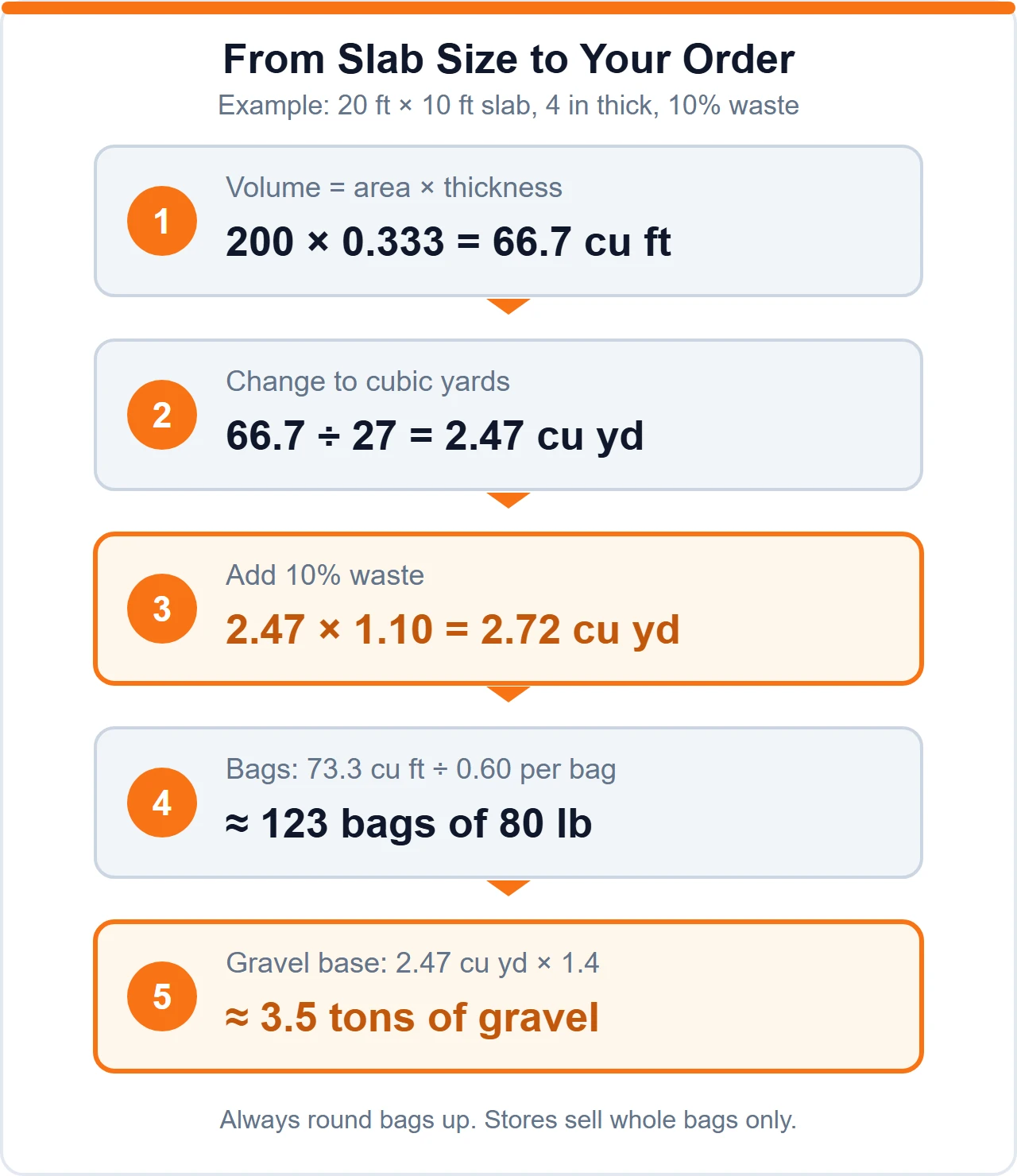
Let me show it with the tool’s default slab. It is 20 ft × 10 ft and 4 in thick. That is 200 sq ft × 0.333 = 66.7 cu ft, or 2.47 cubic yards.
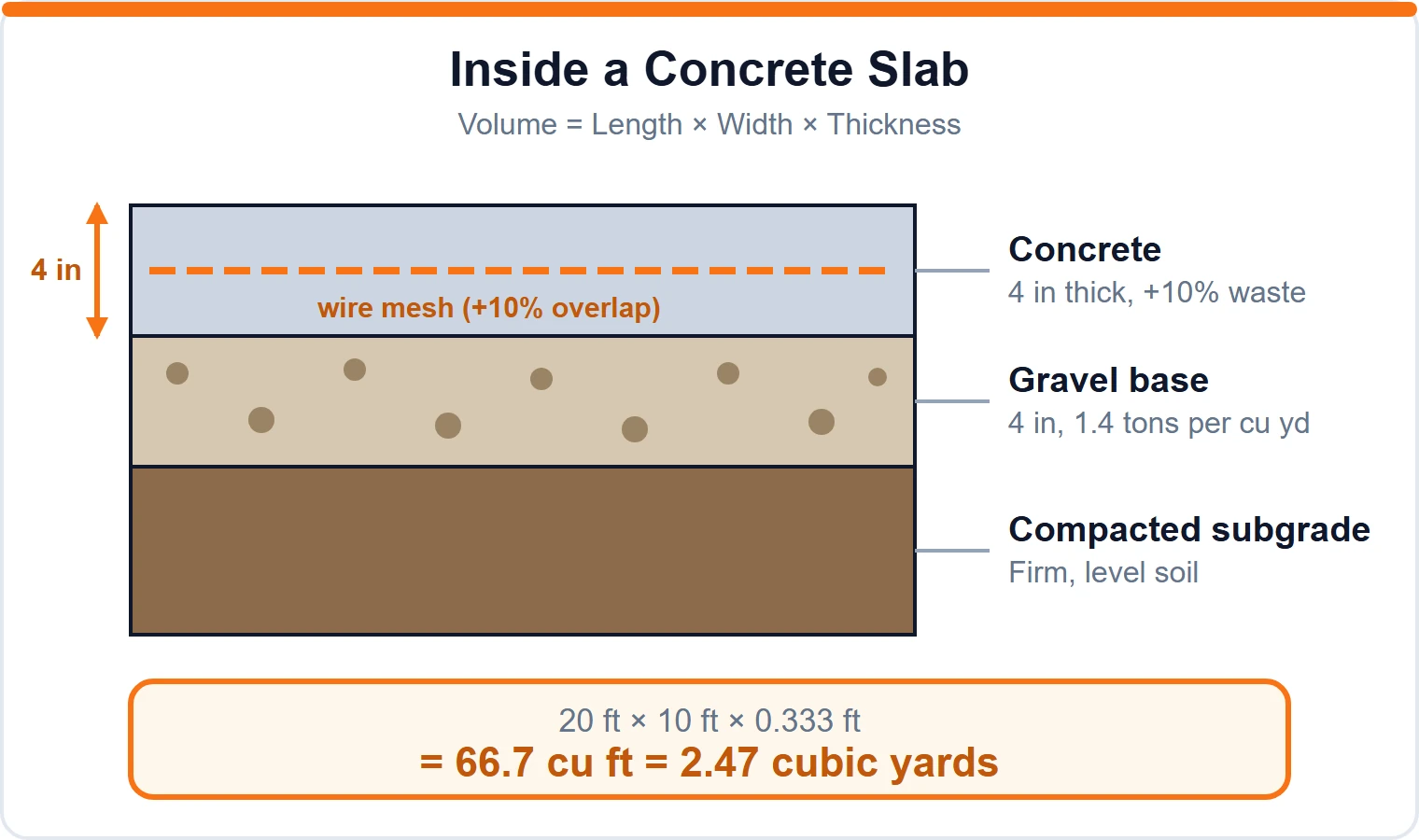
The tool then adds 10% waste by default. Waste covers spills, uneven subgrade and low spots. So 2.47 × 1.10 = 2.72 cubic yards is the number you order.
The cost uses three prices that you type in. The tool starts with example prices of $145 per cubic yard, $28 per ton of gravel and $4.50 per sq ft for labor. These are only examples. Replace them with real quotes from your area.
With those example prices, the 20 × 10 slab comes to $1,390.62. That is $393.83 for concrete, $96.79 for gravel and $900.00 for labor. Want to check your own numbers? Send me your slab size and we can look at it together.
In my professional experience, most people guess the thickness and get the estimate wrong. Thickness is the one number that moves your volume the most. A slab that is 1 inch thicker needs 25% more concrete than a 4 inch slab.
A 4 inch slab is common for patios, walkways and sheds. A driveway or a garage floor often needs 5 to 6 inches. Your local building office has the final say, so ask them before you pour.
The table below uses the tool’s math. It shows common slab sizes at 4 inches thick with 10% waste. The cost uses the example prices from above.
| Slab Size | Area (sq ft) | Cubic Yards (+10%) | 80 lb Bags | Gravel (tons) | Example Cost |
|---|---|---|---|---|---|
| 10 × 10 ft | 100 | 1.36 | 62 | 1.7 | $695 |
| 12 × 12 ft | 144 | 1.96 | 88 | 2.5 | $1,001 |
| 20 × 10 ft | 200 | 2.72 | 123 | 3.5 | $1,391 |
| 20 × 20 ft | 400 | 5.43 | 245 | 6.9 | $2,781 |
| 20 × 30 ft | 600 | 8.15 | 367 | 10.4 | $4,172 |
| 40 × 60 ft | 2,400 | 32.59 | 1,467 | 41.5 | $16,687 |
See the pattern? With the example prices, every row comes to $6.95 per sq ft. Your real price will be different. But it shows that slab cost grows in a straight line with area.
The same math works for round slabs. Use the Circular Patio tab and type the diameter. For other building jobs, our concrete block calculator helps you plan the walls that sit on top of the slab.
You can buy ready-mix from a truck or mix bagged concrete yourself. The right choice depends on volume. One cubic yard equals 45 bags of 80 lb (27 ÷ 0.60).
The tool gives you bags in three sizes. An 80 lb bag makes 0.60 cu ft. A 60 lb bag makes 0.45 cu ft. A 40 lb bag makes 0.30 cu ft.
For our 20 × 10 slab, you need 123 bags of 80 lb. That is a lot of lifting. Each bag weighs 80 lb, so the total is about 9,840 lb. For that size, I would call a ready-mix truck and save my back.
A small patio slab under about 1 cubic yard is fine with bags. Above that, delivery from a truck is faster and the mix is more even. Many plants add a short-load fee for very small orders, so ask for it when you call.
Do not forget the gravel base. It sits under the concrete and helps water drain away. The tool counts it at 1.4 tons per cubic yard. For our example, that is 3.5 tons.
The tool also gives mesh area. It adds 10% for overlap, so a 200 sq ft slab needs about 220 sq ft of wire mesh. If your plan calls for rebar instead, count the bars from your drawing.
Old concrete in the way? The U.S. EPA says concrete and masonry can be recycled on site as fill, subbase material or driveway bedding. That can lower your hauling and gravel cost. The tool has a demolition field for this, so add it if you must break out an old slab.
I’ve seen this pattern many times in my work. The math is easy, but small slips cost real money. Here are the ones I see most.
Here is a story from my friend Usman. He wanted a 12 × 12 ft patio. He did the math at 4 inches and ordered exactly 1.78 cubic yards with no waste.
His ground was a little uneven. Halfway through the pour, the truck was empty and the last corner was still bare. He had to buy 12 extra bags and mix them fast. The patch never matched the rest.
When he called me, I ran his numbers. With 10% waste the order would have been 1.96 cubic yards. That is only 0.18 yards more, and it would have saved his Saturday.
Planning other parts of the job? Our board foot calculator helps with the lumber for forms, and the recessed lighting calculator helps with the ceiling over your new garage or shop. You can find more in our construction calculators hub and the full calculators list.
A good concrete slab estimate starts with three numbers: length, width and thickness. Add 10% waste, round up your bags, and do not forget the gravel base. That one habit saves most people from a short pour.
The cost in this tool is only as good as the prices you type in. Use real quotes, and treat the example prices as a starting point. Then compare a few suppliers, because delivery and short-load fees change the total.
Try the calculator above with your own slab size. If the numbers look strange, send me your size and thickness, and we can walk through it together. A few minutes of planning beats a weekend of fixing.
A 10 × 10 ft slab at 4 inches thick needs about 1.36 cubic yards with 10% waste, or about 62 bags of 80 lb. With the tool’s example prices ($145 per cubic yard, $28 per ton of gravel and $4.50 per sq ft for labor), the total is about $695. Type in your local prices to get a real number.
A 12 × 12 ft slab is 144 sq ft. At 4 inches thick with 10% waste, you need about 1.96 cubic yards or 88 bags of 80 lb. With the tool’s example prices, the total is about $1,001. Real cost depends on your local concrete, gravel and labor prices.
A 20 × 30 ft slab is 600 sq ft. At 4 inches thick with 10% waste, you need about 8.15 cubic yards, which is too much for bags (367 bags of 80 lb). A ready-mix truck is the better choice. With the tool’s example prices, the total is about $4,172.
A 40 × 60 ft slab is 2,400 sq ft. At 4 inches thick with 10% waste, it needs about 32.59 cubic yards and 41.5 tons of gravel. With the tool’s example prices, the total is about $16,687. A job this size needs a contractor and a pump plan, so ask for written quotes.
One cubic yard equals 45 bags of 80 lb, 60 bags of 60 lb, or 90 bags of 40 lb. Find your volume in cubic feet and divide by 0.60 for 80 lb bags, 0.45 for 60 lb bags, or 0.30 for 40 lb bags. Always round up. For a 20 × 10 ft slab at 4 inches thick with 10% waste, you need 123 bags of 80 lb.