Board feet, volume, weight and cost for any lumber
Buying lumber and not sure how much you need? A 2 × 4 × 8 board is 5.33 board feet by its name, but only 3.5 board feet by its real size. This free board foot calculator gives you board feet, volume, weight and cost in seconds.
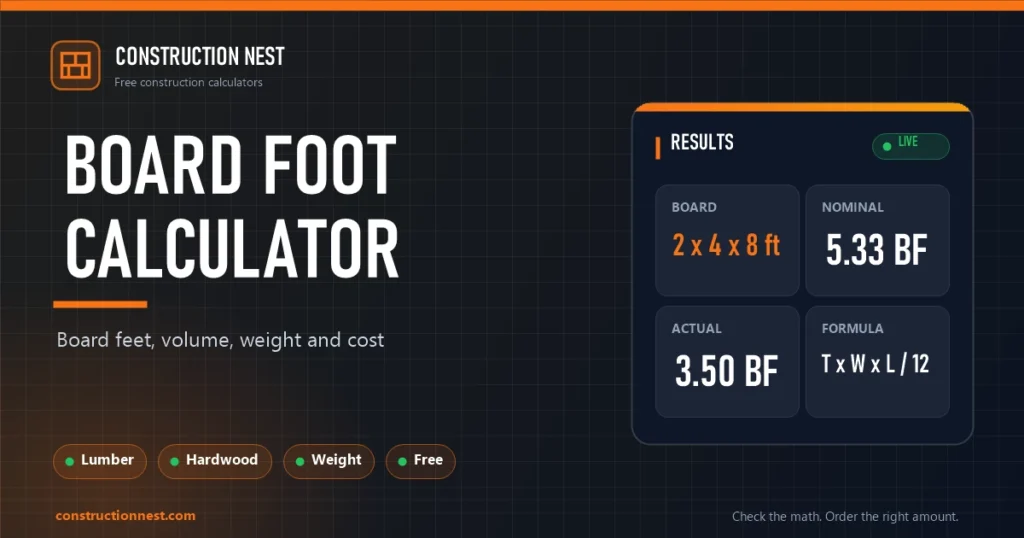
You only need the size of your board and how many pieces you have. It takes about one minute.
Choose Standard Dimensions for normal lumber. Choose Hardwood Quarters if your boards are sold as 4/4, 5/4 or 8/4.
Type the thickness in inches, mm, cm or feet. In quarters mode, pick the quarter size from the list. 4/4 means 1 inch.
Type the board width. You can use inches, feet, mm, cm or meters. The default is 6 inches.
Type the length in feet and inches or another unit. The default is 6 ft 3 in. Then type the number of pieces.
Pick a wood species to see the weight. Type a price and choose per board foot, per piece, per linear foot or per cubic foot to see the cost.
Click Calculate Board Feet. You will see total board feet, board feet per piece, volume, weight and cost. Use Copy Summary, Download PDF or Share Results to save your numbers.
A board foot is a unit of lumber volume. One board foot is a board 12 inches wide, 12 inches long and 1 inch thick. That is 144 cubic inches of wood.
The board foot calculator uses one simple formula. Thickness and width are in inches. Length is in feet.
Board Feet = Thickness (in) × Width (in) × Length (ft) ÷ 12
Let me show it with the tool’s default board. It is 1 in thick, 6 in wide and 6 ft 3 in long. That is 1 × 6 × 6.25 ÷ 12 = 3.13 board feet, or 0.26 cubic feet.
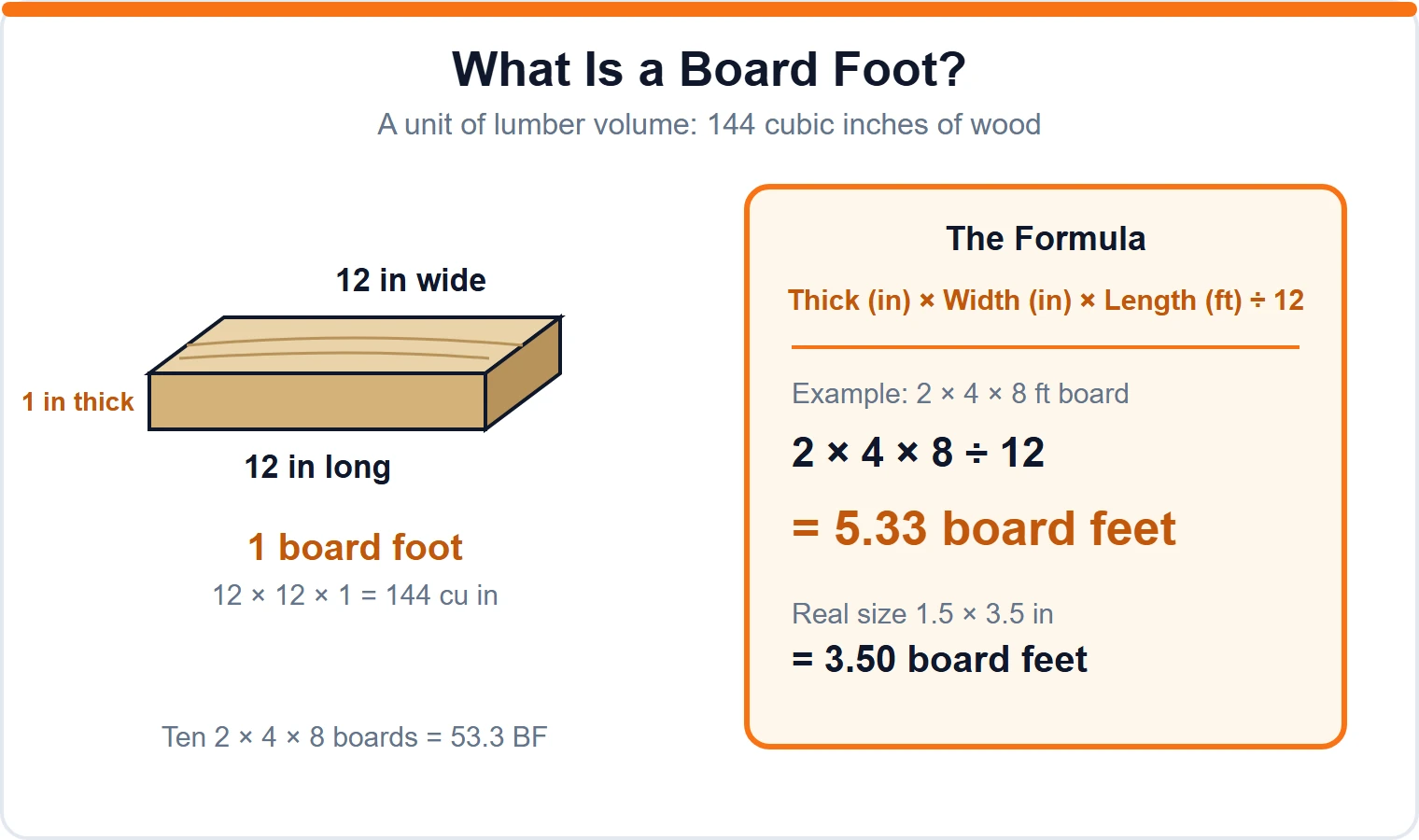
Here is a second example. A 2 × 4 × 8 board gives 2 × 4 × 8 ÷ 12 = 5.33 board feet. Ten of them are 53.3 board feet.
The tool also shows cubic feet, cubic yards, weight and cost. Pick a wood species if you want weight. Type a price if you want cost.
In my professional experience, the biggest board feet mistake is mixing up nominal and actual sizes. A “2 × 4” is the name of the board. It is not the real size. The real size is about 1.5 in × 3.5 in.
That gap changes your answer a lot. A 2 × 4 × 8 counts as 5.33 board feet by its name. By its real size, it holds only 3.5 board feet of wood.
The table shows both numbers for common lumber sizes. Each row is one piece.
| Board (nominal) | Actual Size (in) | BF by Nominal | BF by Actual |
|---|---|---|---|
| 1 × 6 × 8 ft | 0.75 × 5.5 | 4.00 | 2.75 |
| 1 × 12 × 12 ft | 0.75 × 11.25 | 12.00 | 8.44 |
| 2 × 4 × 8 ft | 1.5 × 3.5 | 5.33 | 3.50 |
| 2 × 4 × 10 ft | 1.5 × 3.5 | 6.67 | 4.38 |
| 2 × 6 × 8 ft | 1.5 × 5.5 | 8.00 | 5.50 |
| 2 × 10 × 12 ft | 1.5 × 9.25 | 20.00 | 13.88 |
| 4 × 4 × 8 ft | 3.5 × 3.5 | 10.67 | 8.17 |
Look at the 1 × 12 × 12 row. It is 12 board feet by name, but only 8.44 by real size. That is about 30% less wood than the name suggests.
Which one should you use? Ask your lumber yard how it counts. Then type the matching sizes into the tool. For help with other job parts, try our concrete slab cost calculator for a shop floor.
Hardwood is often sold in quarters. This means thickness in quarter inches. 4/4 is 1 inch, 5/4 is 1.25 inch, 8/4 is 2 inch and 16/4 is 4 inch. The tool has a Hardwood Quarters mode for this.
Let me show one. A 4/4 red oak board is 8 in wide and 8 ft long. The math is 1 × 8 × 8 ÷ 12 = 5.33 board feet, or 0.44 cubic feet.
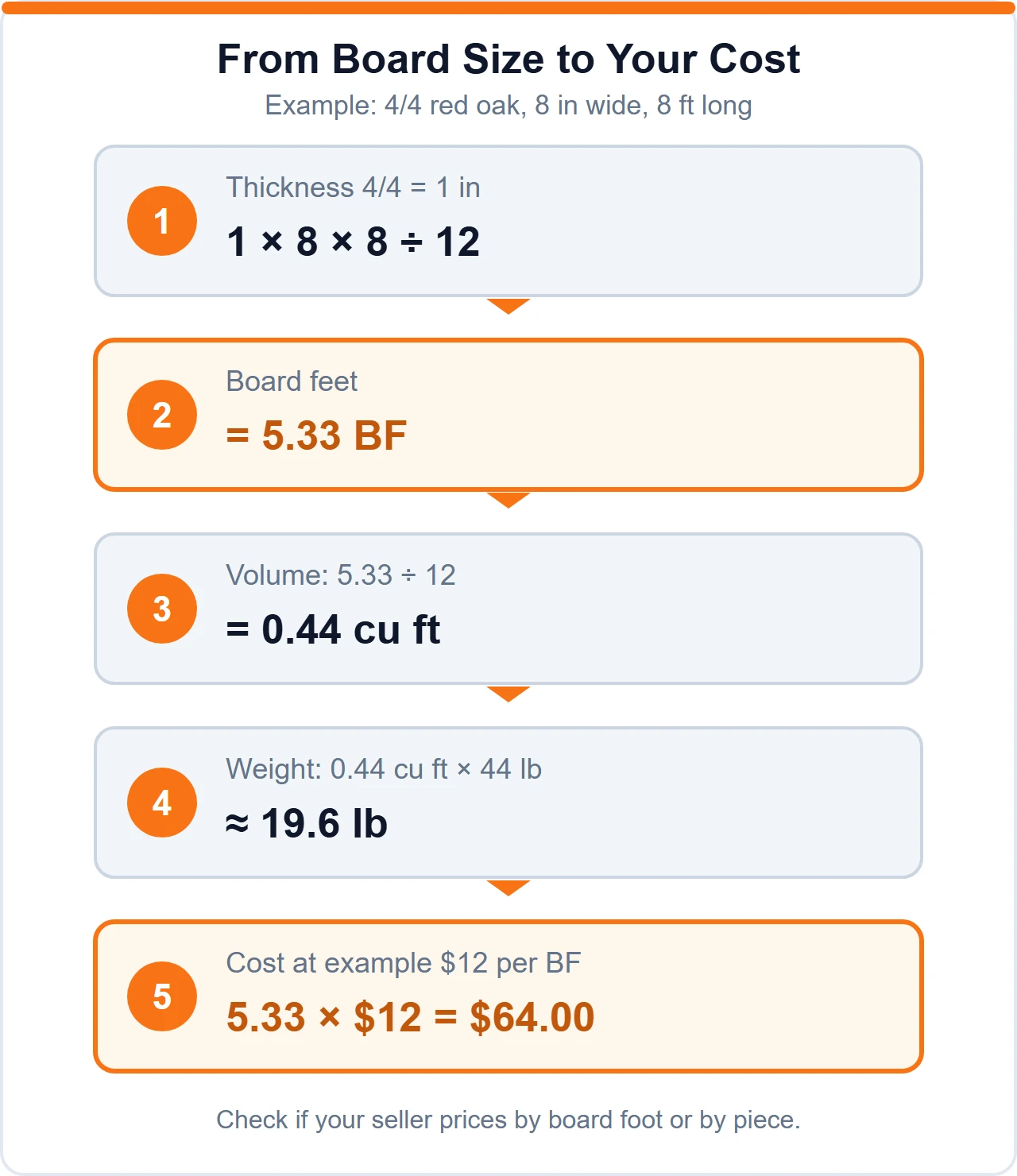
The tool has weights for 15 wood species plus softwood and hardwood averages. Red oak is 44 lb per cubic foot, or 3.67 lb per board foot. So our board weighs about 19.6 lb.
For cost, type a price and pick how the seller charges. You can use per board foot, per piece, per linear foot or per cubic foot. At an example price of $12 per board foot, this board costs $64.00.
The U.S. Forest Service’s Wood Handbook explains how this works. It says that for lumber 1 inch or more thick, the board foot count uses the nominal thickness and width and the actual length. That matches the tool’s formula.
Not sure which size to pick? Send me your board sizes and we can check the numbers together.
I’ve seen this pattern many times in shops. A small slip in the math turns into a pile of extra boards. These are the mistakes I see most.
Here is a story from my friend Imran. He was building a workbench top from 2 × 6 × 8 boards. He needed 40 board feet, and he used the real size of 5.5 board feet per board.
The math said 40 ÷ 5.5 = 7.3, so he bought 8 boards. But his yard billed by nominal size, which is 8 board feet per board. He paid for 64 board feet.
If he had asked first, he would have needed only 5 boards (40 ÷ 8). That is 3 boards saved. He now checks how the yard counts before he orders.
Planning more of the project? Try our recessed lighting calculator for the shop lights and the concrete block calculator for walls. You can find more in our construction calculators hub and the full calculators list.
The board foot formula is short: thickness × width × length in feet ÷ 12. Most mistakes come from the sizes you type in, not from the math.
Ask how your seller counts, add 10% to 20% for waste, and pick the right price type. Those three habits save the most money.
Try the calculator above with your own boards. If a number looks wrong, send me your board sizes, and we can check it together.
Multiply thickness in inches by width in inches by length in feet, then divide by 12. For example, a board that is 1 inch thick, 6 inches wide and 6 ft 3 in long is 1 × 6 × 6.25 ÷ 12 = 3.13 board feet. If all three sizes are in inches, divide by 144 instead.
A 2 × 4 × 8 is 2 × 4 × 8 ÷ 12 = 5.33 board feet by its nominal size. By its real size of 1.5 × 3.5 inches, it holds 3.5 board feet of wood. Ask your seller which one they use, then enter the matching sizes in the calculator.
A 1 × 12 × 12 ft board is 1 × 12 × 12 ÷ 12 = 12 board feet by its nominal size. By its real size of 0.75 × 11.25 inches, it holds about 8.44 board feet.
A 2 × 4 × 10 is 2 × 4 × 10 ÷ 12 = 6.67 board feet by its nominal size. By its real size of 1.5 × 3.5 inches, it holds about 4.38 board feet.
One cubic foot equals 12 board feet. One board foot is 144 cubic inches, which is 0.0833 cubic feet. The calculator shows total volume in cubic feet, cubic yards and cubic meters next to your board feet.